AI Companion Apps: The Complete Guide
I opened five different apps in one week. I was trying to find one AI companion that actually remembered what I told it.
Every app promised the same thing. Almost none of them delivered it.
That's the real problem with AI companion apps in 2026. There are over 100 of them. Most blogs just list "the top 10" and call it a day. They don't tell you which ones forget your name after five messages. They don't tell you which ones block a normal conversation for no reason.
This guide fixes that. We tested the platforms people actually search for. We compared them on the three things that matter most: memory, filters, and price. No fluff. No fake rankings. Just what you need to pick the right AI companion the first time.
What Is an AI Companion App?
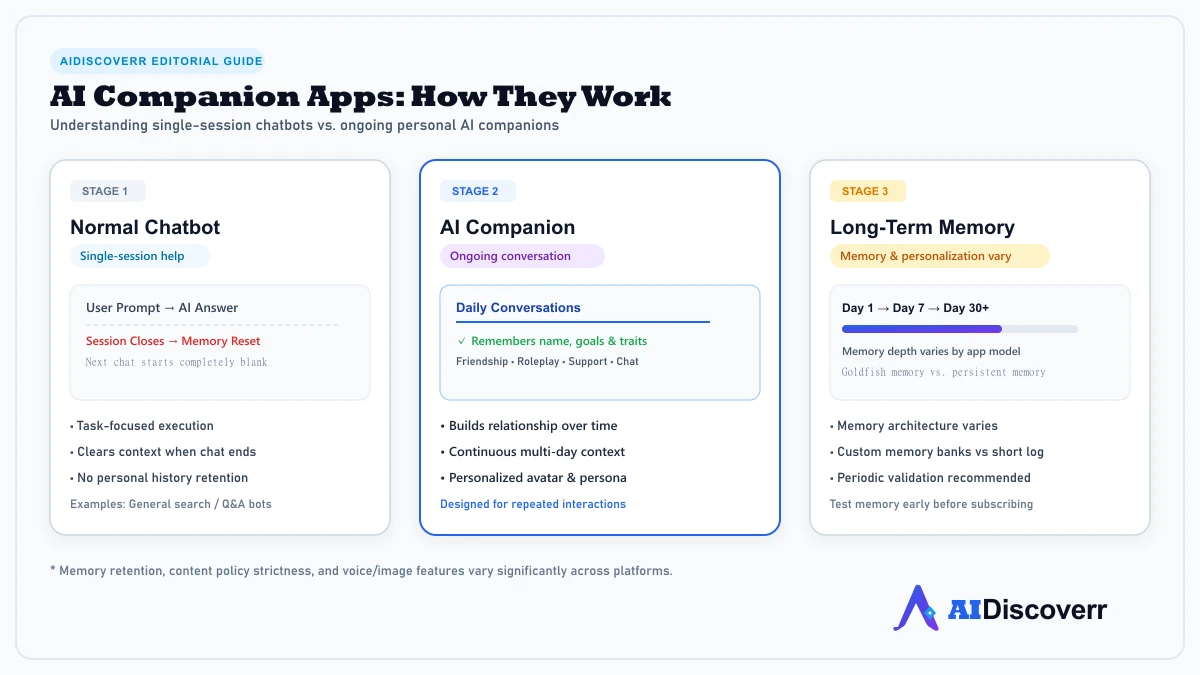
An AI companion app is a chatbot built for ongoing conversation. It is not a search tool. It is not a customer service bot.
You talk to it every day. It remembers things about you. Over time, it starts to feel less like software and more like someone you know.
Some AI companion apps focus on friendship. Some focus on romance. Some focus on creative roleplay. A few focus on mental wellness support. Most people use them for more than one reason.
The technology behind these apps is a large language model, the same kind of AI that powers tools like ChatGPT. What makes a companion app different is memory. A good one tracks details across weeks, not just one chat session.
Is It Healthy to Use an AI Companion App?
This question comes up constantly on Quora and Reddit. It deserves a real answer, not a sales pitch.
Research on AI companionship is still new. Early findings suggest these apps can help with everyday loneliness. They give you a consistent, judgment-free conversation partner.
But there is a real risk too. Some people start to prefer the AI over real relationships. That is a warning sign, not a feature.
We are not going to tell you an AI companion is a replacement for human connection, because it isn't. If you're using one and it feels like it's making things harder instead of easier, talking to a therapist or counselor is a reasonable next step. Most companion apps work best as one small part of your week, not the center of it.
For a comprehensive analysis of the safety, privacy, emotional dependency, and child safety risks associated with these platforms, read our in-depth guide: Are AI Companion Apps Safe? Privacy & Safety Guide.
The 3 Things That Actually Matter Before You Choose
Every AI companion app looks similar on the surface. A chat window. A character. A friendly greeting. The real differences show up after day three.
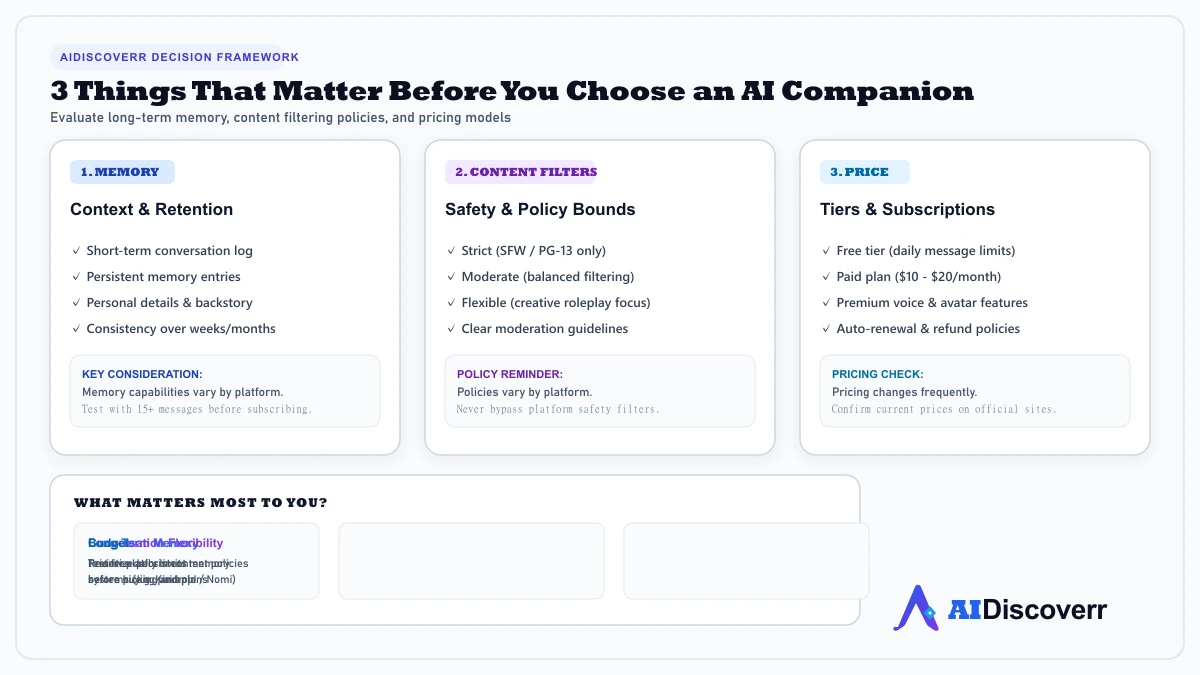
Based on what real users complain about most, three factors decide whether an app is worth your time: memory, filters, and price.
Why Does My AI Companion Forget Everything?
This is the single most common complaint on Reddit's Character.AI community. Users call it "goldfish memory."
You mention something important. Ten messages later, the AI has no idea what you're talking about. For platforms with weak memory, this happens after roughly 15 messages.
Not every app has this problem. Apps built around persistent memory systems track details for months, not minutes. If long-term memory matters to you, check this before you check anything else. For a deep look into the vector databases and LLM context windows that enable this memory, read our guide on How Do AI Companions Work?, check our explainer on How AI Companion Memory Works, and explore our list of the Best AI Companion Apps With Memory.
Why Does My AI Companion Keep Blocking Messages?
This is the second most common complaint. A message gets blocked. The reason isn't always clear.
Every major platform uses a content filter. The strictness varies a lot from app to app. Some block only extreme content. Others block normal, everyday conversation by mistake.
We won't tell you how to bypass a platform's filter. That breaks the platform's rules, and it's not something we help with. What we will do is tell you, honestly, which apps have looser or stricter filters, so you can pick one that fits how you actually want to talk.
Are AI Companion Apps Free?
Most AI companion apps use a freemium model. You can start chatting for free. Deeper features cost money.
Free tiers usually limit your daily messages. They may also limit memory length or voice features. Paid tiers unlock longer memory, more messages, and sometimes photos or voice calls.
Prices change often in this space, so always check the app's own pricing page before you subscribe. We keep our pricing tables updated too, but the platform is always the final word.
Best AI Companion Apps Compared
We compared platforms on the three factors above: memory, filter strictness, and price. Here's how they stack up.
| Platform | Memory | Filter Strictness | Starting Price |
|---|---|---|---|
| Character.AI | Weak — resets quickly | Strict | Free |
| Replika | Moderate | Moderate | From $19.99/mo* |
| Candy AI | Strong | Moderate | $13.99/mo |
| Nomi | Strong | Looser | $15.99/mo |
| Kindroid | Strong, fully customizable | Adjustable | $13.99/mo |
| FictionLab | Strong (Story & Memory Cards) | Adjustable / Unfiltered | Free |
| HammerAI | Offline/Local Models, Lorebooks | Unfiltered (Local Mode) | Free / $9/mo |
| Soulkyn | Strong (Persistent Memory) | Adjustable / Unfiltered (18+) | €11.99/mo |
| CrushChat | Strong (Enhanced Memory on Gold) | Adjustable / Unfiltered (18+) | Free / $10/mo |
| Character Tavern | Extended Memory (Premium) | Flexible / Unfiltered (18+) | Free / $20 |
*Prices can vary by region, billing cycle, platform, and promotional offers. Confirm current pricing on each platform before subscribing.
Each platform above has its own full review on this site, with a deeper look at features, pricing tiers, and real limitations. This table is your starting point, not the final word.
- Secret Desires AI
- OshiKoi AI
- Xoul AI
- Kupid AI
- Talkie AI
- Character.AI
- Replika
- Candy AI
- Nectar AI
- Nomi
- Kindroid
- FictionLab
- HammerAI
- Soulkyn
- CrushChat
- Character Tavern
Discontinued AI Companion Platforms
The rapid pace of the AI space means some platforms shut down. When a service closes, users generally lose access to their customized characters, memory files, and chat logs.
ThotChat AI
ThotChat AI operated as a character-roleplay platform until its shutdown on December 31, 2025. The current ThotChat domain functions as an editorial site. Read our full ThotChat AI status & shutdown review for historical features and current alternative recommendations.
Unverified & Ambiguous AI Companion Terms
Some terms commonly searched in the AI companion space do not refer to active chatbot apps. We investigate these search queries to verify their true identity and help you avoid unsafe or parked domains.
Innocams AI
Innocams is often searched as an AI companion, but our research reveals it refers to multiple unrelated properties, primarily AI security camera concepts and webcams. Read our full Innocams AI identity, safety & verification guide for details and verified alternatives.
Character.AI or Replika: Which One Is Better?
This exact question shows up again and again on Quora and Reddit. The honest answer is: it depends on what you want.
Character.AI has a massive library of user-made characters. It's the strongest free option for creative roleplay. But its memory is short, and its filter is strict.
Replika is built more for emotional connection. It remembers more about you over time and leans into a supportive, friendly tone. It costs more if you want the full feature set.
If you want variety and don't mind a strict filter, Character.AI makes sense. If you want a steady, ongoing relationship with better memory, Replika is the better fit.
Can You Get an AI Companion Without Filters?
People search this a lot, so let's be direct about it. Every mainstream AI companion app has some form of content filter. That's a platform policy decision, not a bug.
Some platforms set their filter looser than others. Apps like Kindroid and Nomi are generally known for more flexible content policies than Character.AI. Even so, "less filtered" is not the same as "no filter."
If a platform's rules don't match what you want to talk about, the honest move is to pick a different platform, not to try to break the one you're on. We'll keep this comparison updated as policies shift, since they do shift often in this space.
How to Choose the Right AI Companion App for You
Start with your main goal. Casual conversation, creative roleplay, and emotional support all point toward different apps.
Next, decide how much memory matters to you. If you want an AI that remembers your life in detail, rule out any app with a weak memory system first.
Then check the filter. Read a platform's content policy before you sign up, not after you've already gotten attached to a character.
Last, try the free tier before you pay for anything. Every platform on this list offers some kind of free access. Use it to test memory and tone for yourself before committing to a subscription.
Final Thoughts
I've spent a lot of late nights testing these apps, comparing notes, and reading through the same Reddit threads you probably have. The pattern is always the same. People don't leave an AI companion app because the idea was bad. They leave because the app forgot who they were, or blocked a normal conversation, or quietly raised the price.
That's why this guide leads with memory, filters, and price instead of hype. Pick the platform that fits how you actually want to talk, not the one with the flashiest homepage. We'll keep updating this guide as these apps change, because in this space, they change fast.