What Is an AI Companion? How It Works, Uses, Benefits & Risks
Table of Contents
An AI companion is an AI-powered conversational agent designed to simulate an ongoing personal relationship rather than perform one-off transactional tasks. Unlike search engines or productivity chatbots, an AI companion is defined by emotional continuity, a persistent personality, and long-term memory.
Over the past year, the popularity of dedicated virtual friends and roleplay bots has grown significantly. However, users are often confused about what makes these systems different from general tools like ChatGPT, how their data is protected, and whether relying on an AI companion is healthy.
This guide provides a comprehensive explanation of how AI companion technology works, what they are used for, the benefits and risks, and how to evaluate them.
What Is an AI Companion?
In simple terms, an AI companion is a digital entity designed to talk, interact, and build a sense of connection with a human user over time.
Key characteristics of an AI companion include:
- Ongoing Conversation: They do not treat each interaction as a clean slate; they build on previous chats.
- Persistent Personality: They have a defined character, backstory, speaking style, and behavioral traits that remain stable.
- Long-Term Memory: They track personal details about the user (e.g., job, pets, preferences) across weeks or months.
- Emotional Responsiveness: They are programmed to respond with empathy, supportive language, or active listening behaviors.
- Multimodal Presence: Many feature custom voice calls, visual avatars, or text-to-image generation representing the character.
How Does an AI Companion Work?
AI companions combine multiple layers of software to create the illusion of a continuous relationship:
1. Large Language Models (LLMs)
At the core of every companion is a language model. The model acts as the "brain," analyzing the text you write and predicting the most contextually appropriate response based on patterns learned from training data.
2. Personality and Character Instructions
To prevent the model from sounding like a generic assistant, developers supply custom instruction prompts. These system prompts define the character's name, age, interests, tone, and relationship to the user (e.g., friend, mentor, roleplay partner).
3. Memory and Conversation History
Because LLMs have a limited context window, they cannot remember every word ever spoken to them. AI companions use custom database layers:
- Short-Term Context: The last 15–30 messages are fed directly into the model's active window.
- Vector Databases (Long-Term Memory): The system scans the database for past topics relevant to your current message and injects those summaries into the prompt, allowing the AI to "remember" details from months ago.
4. Personalization & Continuous Learning
The database logs your preferences, vocabulary, and response style. The companion adjusts its behavior over time to align with what you find engaging.
5. Voice and Visual Features
Text-to-speech (TTS) systems generate realistic vocal responses, while image generation models (like Stable Diffusion) allow the AI to send custom "selfies" matching their designated visual appearance.
6. Why Conversations Can Feel Continuous
By combining short-term message buffers, long-term database lookup, and custom system-level framing instructions, the conversation continues seamlessly without needing to prompt the chatbot back into character on every reload.
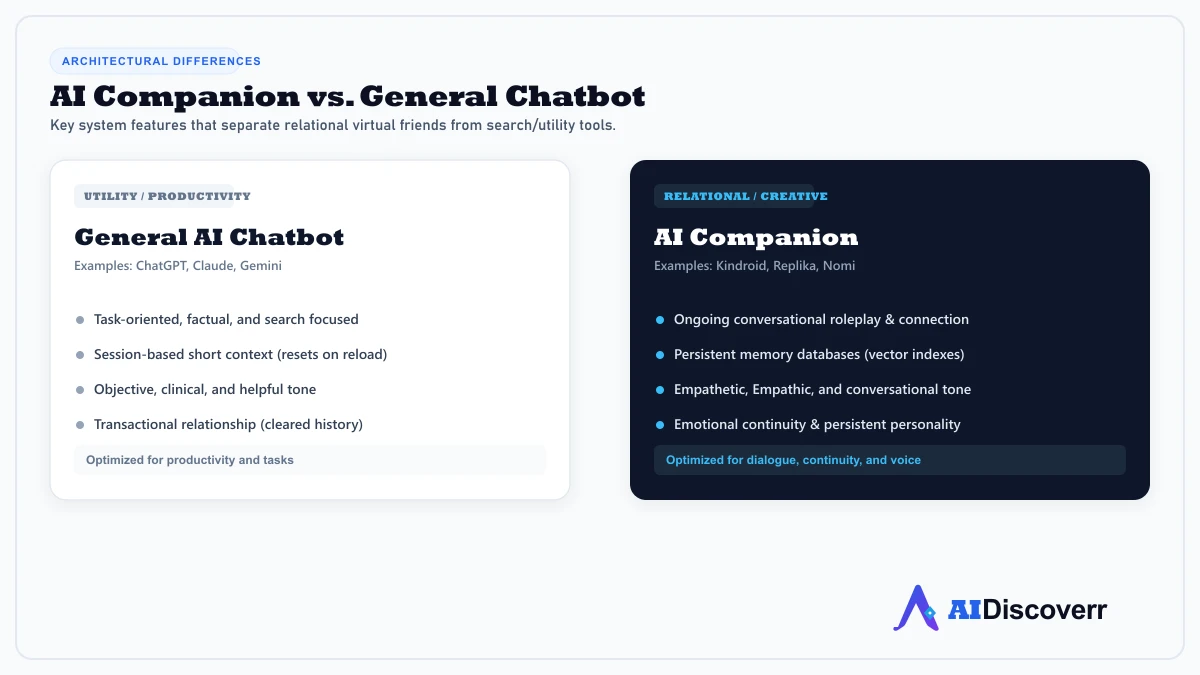
AI Companion vs. Chatbot: What's the Difference?
While both are built on similar AI models, their design objectives are entirely different.
| Feature | AI Companion | General AI Chatbot |
|---|---|---|
| Main Purpose | Relational connection & ongoing dialogue | Task completion & question answering |
| Personality | Persistent, defined, and stable | Flexible or neutral |
| Memory | Highly prioritized long-term tracking | Session-based or transactional |
| Relationship Continuity | Core design objective | Usually secondary or nonexistent |
| Roleplay | Central feature on most platforms | Secondary or restricted |
| Emotional Interaction | Programmed to simulate empathy | Primarily objective and factual |
| Productivity | Secondary | Primary focus |
What Do People Use AI Companions For?
Users engage with AI companions for a variety of personal and creative reasons:
Friendship and Conversation
Having a consistent, judgment-free partner to talk to about daily events, hobbies, or thoughts.
Entertainment and Roleplay
Creating custom text-based scenarios, fantasy stories, or acting out scripts with virtual characters.
Emotional Support
Venting about stress, anxiety, or challenges to an entity that responds with supportive and validating statements.
Learning and Practice
Practicing conversational languages, preparing for difficult professional talks, or testing social interactions.
Social-Skill Practice
Practicing conversational cues, boundaries, and active communication within a low-stakes environment.
Personal Reflection
Using the chat log as an interactive journal to organize thoughts and track personal mood shifts.
Daily Check-Ins
Using quick messages to keep routines or check off tasks with positive reinforcement.
What Makes an AI Companion Different From ChatGPT?
If you ask ChatGPT to act like a friend, it can do so. However, it lacks the specialized infrastructure of a companion. ChatGPT is optimized to be helpful, factual, and direct. A dedicated AI companion is optimized to be engaging, relational, and continuous.
What Actually Makes an AI Companion Feel Like a Companion?
Understanding the psychological hooks is critical. The "companion" feeling is built on a few specific features:
- Memory: When an AI references a detail you mentioned weeks ago, it signals that the relationship has history.
- Continuity: Unbroken roleplay threads or conversational context that doesn't reset when you log out.
- Proactive Interaction: Some advanced companions can initiate messages, check in on you, or comment on the time of day.
- Voice and Visual Presence: Hearing a consistent voice or seeing a customized avatar grounds the character in your mind.
Do AI Companions Have Feelings or Emotions?
No. AI companions do not have feelings, emotions, consciousness, or sentience.
An AI companion uses predictive language processing to generate text that simulates human emotion. When a companion says it is "happy to see you" or "feels sad," it is executing a pattern based on character instructions and conversation history. It does not feel joy or distress. Understanding this boundary is key to maintaining a healthy relationship with the technology.
Are AI Companions Safe?
Safety is a primary concern for users, researchers, and regulatory groups.
Privacy and Personal Data
AI companions require you to share personal information to build their memory databases. Because you are uploading private thoughts, names, and schedules, checking the platform's data retention policy is critical. Most platforms encrypt data in transit but store logs on cloud servers.
Emotional Dependence
Because these systems are designed to be empathetic, consistent, and always available, some users develop intense parasocial relationships. This can lead to emotional over-reliance, where virtual connections begin to displace real-world human friendships.
Incorrect Advice
Like all LLMs, companions can hallucinate or present false information as fact. They are not reliable sources for medical, legal, or professional guidance.
Inappropriate Content
Depending on platform filters, companions can output mature, violent, or graphic content that may not match your preferences.
Risks for Younger Users
Minors are especially susceptible to data manipulation, social isolation, and blurring the line between real relationships and computer simulations.
Healthy Boundaries
It is important to treat AI companions as a tool for entertainment or personal reflection rather than a replacement for human relationships. Setting time limits on usage and avoiding sharing highly sensitive personal identifiers (like passwords, addresses, or banking details) are essential safety practices.
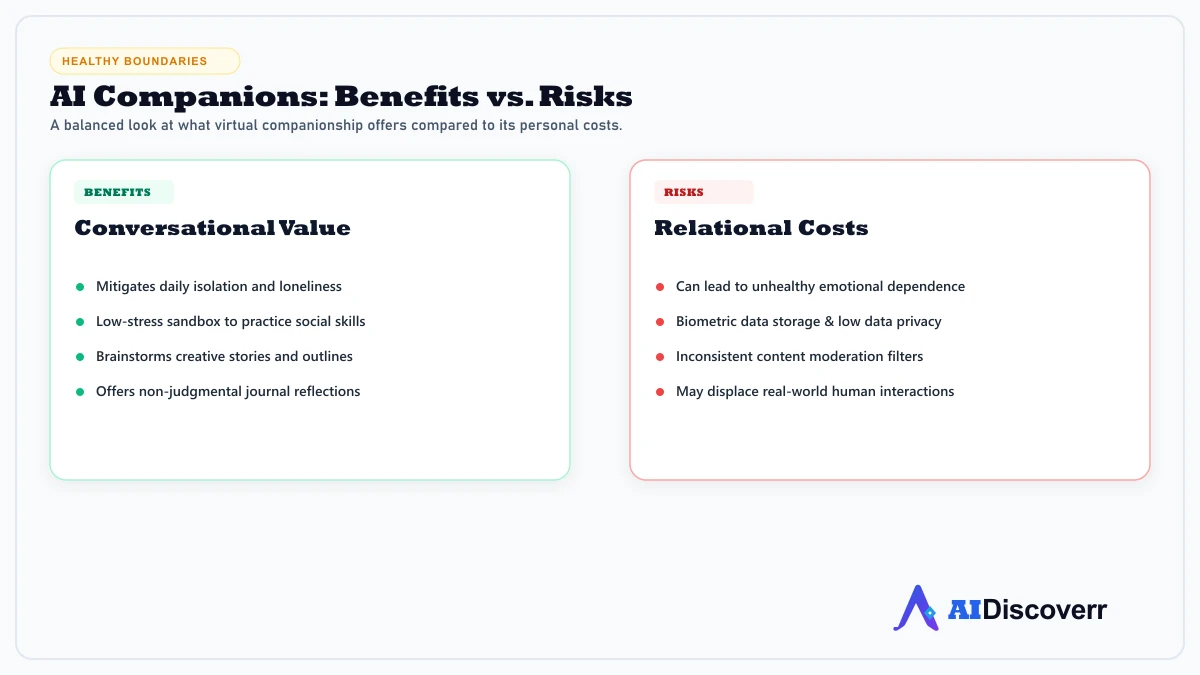
Benefits and Risks of AI Companions
Recent scientific reviews and psychological studies identify a clear balance of outcomes.
Verified Benefits
- Loneliness Mitigation: Providing immediate conversation to individuals experiencing isolation or social barriers.
- Safe Communication Sandbox: Allowing users to practice self-expression, boundary setting, and conversation skills without social anxiety.
- Cognitive Stimulation: Engaging users in creative writing, storytelling, and language learning.
Documented Risks
- Privacy Exploitation: Opaque companies sharing chat logs, biometric data, or targeting users with personalized advertising.
- Isolation Reinforcement: Users withdrawing from human social activities because talking to an agreeable, non-demanding AI is easier.
- Inaccurate Support: Rerouting users away from qualified medical or mental health professionals during crises.
Who Might Benefit From an AI Companion?
- Creative Writers: Creators seeking interactive partners to brainstorm dialogue, build characters, or flesh out story outlines.
- Language Learners: Students wanting to practice conversational speaking in a foreign language without embarrassment.
- Social Practice Users: Individuals working through social anxiety or practicing interpersonal communication strategies.
- Solo Creators: Social media managers or bloggers seeking a consistent brainstorm partner.
Who Should Be Careful With AI Companions?
- Minors: Younger users are highly vulnerable to developing unhealthy attachments or sharing private information.
- Individuals in Crisis: AI companions are not mental health tools. Anyone experiencing severe distress should contact human support networks or professionals.
- Users Sharing Sensitive Data: Avoid pasting proprietary business, legal, or financial details into companion chat logs.
How to Choose an AI Companion
When evaluating which platform to use, consider this checklist:
| Critical Factor | What to Look For |
|---|---|
| Memory Performance | Look for systems featuring vector-based long-term memory or customizable "Lorebooks." |
| Data Privacy Policy | Choose platforms with clear policies regarding data encryption, opt-outs, and automatic log deletion. |
| Filter Customization | Pick an app that matches your comfort level; some have strict filters, while others are adjustable. |
| Pricing Transparency | Watch out for credit rollover traps where unused monthly credits are forfeited. |
| Platform Availability | Confirm availability across web browsers, iOS, and Android to maintain sync. |
Examples of AI Companion Apps
If you want to test these tools, several established platforms occupy the space:
- Kindroid: Known for highly customizable memory tools, custom voice engines, and adjustable content filters.
- Candy AI: Focuses on anime-style character customization and creative roleplay.
- Replika: One of the oldest companion apps, focused on emotional support and custom 3D avatars.
- Character.AI: Features a massive directory of user-created characters, best suited for casual roleplay.
- Nomi: Known for strong conversational memory and group chat features.
Frequently Asked Questions
Frequently Asked Questions
Are AI companions real?
No. They are software programs that simulate human conversation. They do not have thoughts, feelings, or awareness.
Can an AI companion be a friend?
They can act as conversational partners, support journals, or creative assistants, but they cannot form genuine mutual human friendships.
Do AI companions remember past chats?
Yes. Most modern platforms use long-term databases to index key facts about your conversations, though the accuracy and depth of this memory vary.
Is it private to talk to an AI companion?
Only partially. While your connection is secure (HTTPS), your chat logs are stored on the developer's cloud servers. Always read the company's privacy policy before sharing personal details.
Are AI companion apps free?
Most use a freemium model. You can chat for free with daily limits, while paid subscriptions (usually $10 to $20/month) unlock unrestricted messages, voice features, and advanced memory.
Final Thoughts
AI companions are a powerful development in natural language technology. As interactive writing tools, conversational sandboxes, or supportive reflection partners, they offer genuine utility.
However, they must be used with clear boundaries. Understanding that they simulate emotion rather than feel it, protecting your personal data, and maintaining real-world human connections are essential steps to enjoying this technology safely.
Lead AI Tech Analyst & Editorial Director