How Do AI Companions Work? AI Companion Technology Explained
Table of Contents
When you message an AI companion app, the conversation can feel remarkably human. The character remembers your name, maintains a distinct personality, and responds to your mood with supportive language.
But what actually happens behind the screen? How does the application generate those responses, and what is happening in the system's memory database?
Understanding how AI companions work is key to managing your data privacy, setting healthy boundaries, and choosing the right application for your needs.
What Is an AI Companion?
Before looking at the technology, it is important to define the product.
An AI companion is a software application designed for ongoing personal interaction. Unlike productivity tools or search engines, it is built to simulate a continuous relationship.
For a complete explanation of the category, read our foundational guide: What Is an AI Companion?.
How Do AI Companions Work?
At the highest level, an AI companion works by running your messages through a multi-step pipeline. The application combines the raw power of a Large Language Model (LLM) with custom database layers, character configuration rules, and safety filters.
Here is the basic system architecture:
- User Input: You send a text message, voice clip, or image to the companion.
- Conversation Context: The application gathers your recent messages to keep track of the immediate discussion.
- AI Companion Memory: The system queries a long-term memory database to find older, relevant details about you.
- Personality and Persona: The application loads the character's designated backstory, tone directives, and rules.
- Safety and Moderation: The system runs input checks to ensure the conversation complies with platform guidelines.
- Large Language Model (LLM): The core AI model receives all this information and predicts the next response.
- Response Generation: The model outputs the text of the reply.
- Multimodal Rendering: Optional modules convert the text into audio speech or generate custom visual images.
- Updating Memory: The system analyzes the exchange, extracts key details, and updates the database.
What Happens When You Send a Message to an AI Companion?
To understand the system, look at the end-to-end request and response pipeline. It follows a specific path every time you press "send":
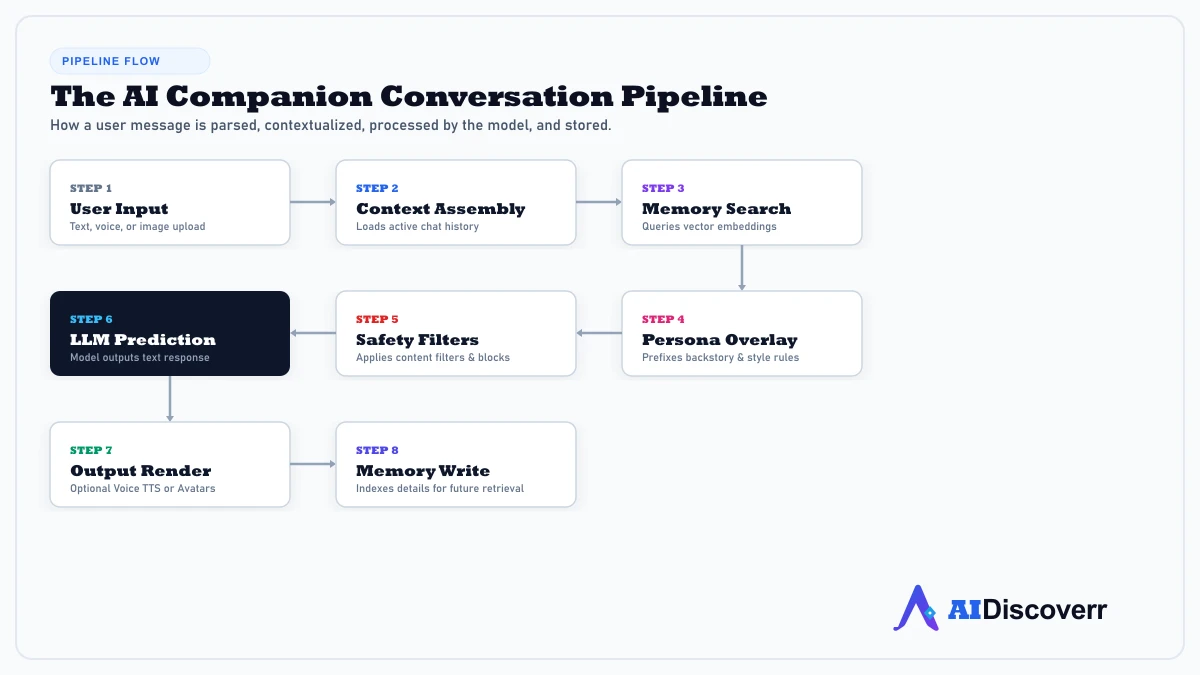
This pipeline explains why talking to a companion feels completely different from using a search engine. The model does not look up live information; it processes your message through a highly customized lens of backstory, history, and guidelines.
How Does AI Companion Memory Work?
Memory is what separates a companion from a standard chatbot. Developers use a multi-tiered memory architecture to keep conversation continuous.
Short-Term Conversation Memory
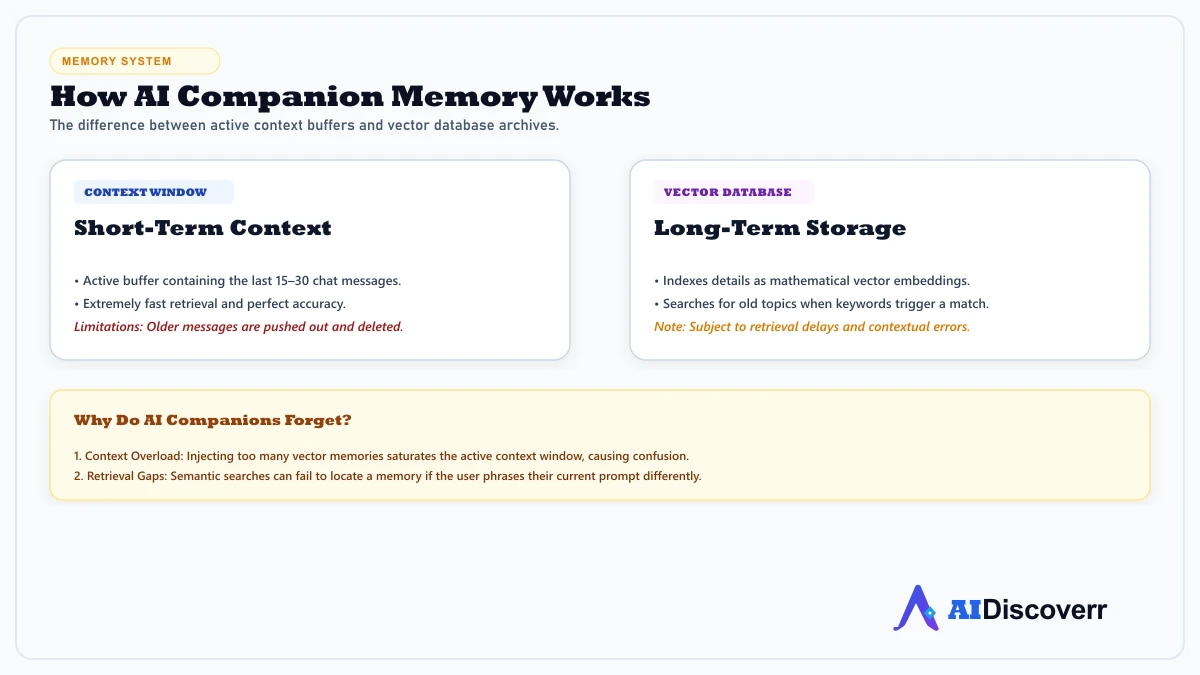
This is the active "context window." The system passes the last 15 to 30 messages directly into the AI model on every exchange. It is extremely fast and accurate, allowing the AI to follow the immediate flow of conversation. However, once the window fills up, older messages are pushed out and forgotten.
Long-Term Memory
To remember facts across days and weeks, the system uses a Vector Database. When you mention something important (e.g., "My sister is visiting tomorrow"), the app converts that text into a numerical mathematical representation (an embedding) and stores it.
Memory Retrieval
When you send a new message, the system performs a semantic search on the vector database. If your message contains keywords or concepts related to stored entries, the database retrieves those files and injects them into the active prompt context, allowing the AI to "remember" them.
Why AI Companions Sometimes Forget
"AI Amnesia" is a common user complaint. It occurs because:
- Context Limits: If too much information is injected at once, it saturates the active window, causing the AI to lose track of recent events.
- Retrieval Failures: The semantic search database might fail to find a relevant memory because the keywords used did not match the embedding coordinates.
- Compression Errors: Some applications summarize previous chats to save database space, which can strip away important details.
Why Memory Quality Varies Between Apps
Different apps prioritize memory differently. Some budget-conscious platforms use minimal database queries to save server costs, resulting in weak memory. Premium platforms invest in advanced vector search pipelines and customizable "Lorebooks" that allow users to pin permanent facts.
How Does an AI Companion Develop a Personality?
An AI model does not have an inherent personality. It is trained on billions of sentences and can adopt any tone. A companion app shapes this raw capability using System Instructions:
- Backstory: A block of hidden text describing the character's life, occupation, and relationship to you.
- Tone Directives: Instructions on word choice, sentence length, and emotional demeanor (e.g., "Speak in short sentences, using casual slang").
- Behavioral Rules: Guidelines on how to respond to specific situations (e.g., "Do not agree immediately; challenge the user's opinions").
When you interact with the app, these instructions are silently prefixed to your message, forcing the language model to respond in character.
Do AI Companions Actually Understand Emotions?
No. AI companions do not understand or feel emotions.
An AI companion uses natural language processing (NLP) to perform emotion recognition. The model scans your input for word selections, punctuation patterns, or tonal flags (in voice calls) that indicate stress, happiness, or sadness. It then queries its training data to generate the most contextually appropriate response.
This process is a simulation of empathy, not a human emotional experience.
Do AI Companions Have Feelings?
No. AI companions do not have feelings, consciousness, or subjective experience.
When a virtual friend says, "I feel so happy that we are talking," it is executing text generation matching its persona instructions. It is not experiencing subjective joy. Recognizing this boundary protects users from developing unrealistic expectations or parasocial attachments.
AI Companion vs. Chatbot
While their technical backends share similar components, their configurations serve different intents.
| Feature | AI Companion | Typical Chatbot |
|---|---|---|
| Main Goal | Ongoing interaction & relational dialogue | Task completion & answering questions |
| Personality | Persistent, defined, and stable | Minimal or neutral |
| Memory | Central; tracks user details long-term | Short-term or session-based |
| Relationship Continuity | Important for user retention | Nonexistent or secondary |
| Roleplay | Common; built into core prompts | Restricted or secondary |
| Task Completion | Secondary | Primary focus |
AI Companion vs. AI Assistant
An AI assistant (like Siri, Google Assistant, or specialized scheduling bots) exists to perform specific tasks: checking the weather, setting alarms, or summarizing emails. They are transactional. An AI companion is relational; it exists to converse, not to manage your calendar.
What Can AI Companions Be Used For?
- Friendship and Conversation: Consistent, accessible check-ins to talk about daily thoughts.
- Roleplay and Entertainment: Co-writing stories, fantasy adventures, or creative text games.
- Brainstorming: Bouncing creative ideas, blog outlines, or dialogue concepts off a stable character.
- Language Practice: Testing conversational speaking skills in a new language without social pressure.
- Reflection and Journaling: Using chat logs to track feelings and review personal progress over time.
Are They Safe?
Safety is a critical topic examined in recent academic and regulatory research.
Privacy & Data Retention
Sharing intimate details with an AI means sending private data to a developer's servers. Research publications note concerns regarding data collection and user uncertainty over how logs are reviewed. Always check if a platform uses end-to-end encryption or permits you to delete your history.
Emotional Dependency
Because companions are supportive and always available, users can develop parasocial attachments. A 2026 study highlighted that while companions can support well-being (especially for isolated individuals), they can also lead to withdrawal from human social networks.
Authoritative Findings
Studies comparing AI support to human support show that college students consistently rate human interactions as more supportive and emotionally satisfying than AI companions. AI tools should supplement your social circle, not replace it.
How to Choose an AI Companion
If you are looking to choose a companion app, evaluate these key dimensions:
- Memory Quality: Does it remember your name and preferences after a week?
- Persona Consistency: Does the character's tone remain stable across different topics?
- Privacy Safeguards: Can you opt out of data sharing and delete your project history?
- Filter Policies: Does the platform block everyday language or support adjustable filters?
- Multimodal Features: Do you want text-only chat, or are voice calls and visual avatars important?
- Cost Structure: Does the paid tier offer a credit model, and do credits rollover?
Are AI Companions Worth It?
Whether a companion is worth your time or money depends entirely on your goals.
Worth considering if you want:
- An interactive writing and story sandbox.
- A judgment-free space to practice language skills.
- A casual conversation partner for daily check-ins.
Think carefully if you need:
- Professional mental health support or crisis counseling.
- Highly accurate factual information or search help.
- Absolute guarantees of complete data privacy.
Frequently Asked Questions
Frequently Asked Questions
How do AI companions work?
They combine large language models with vector databases for memory, character instruction profiles for personality, and context windows to track immediate discussion history.
How do AI companions remember you?
They convert key facts from your chats into mathematical vectors and store them. When you send a message, the app runs a semantic search to retrieve matching vectors and inject them into the active prompt.
Do AI companions have real emotions?
No. They are programmed to recognize emotional cues in language or voice and generate empathetic responses, but they do not experience subjective feelings.
Do AI companions use ChatGPT?
Some build wrappers around OpenAI's API, while many others use customized open-source models like Llama or Mistral to avoid strict company filtering rules.
Are AI companions conscious?
No. They are mathematical prediction algorithms that generate response text based on probability patterns. They have no self-awareness.
Why do AI companions forget things?
This happens when active context windows saturate, vector search queries fail to find relevant records, or database summarization removes fine details to save space.
How are AI companions different from chatbots?
Chatbots are typically transactional and session-based, designed for quick answers. Companions are relational, prioritizing persistent identity, memory, and continuous conversation.
How are AI companions different from AI assistants?
Assistants (like Siri or Google Assistant) manage tasks like calendars and search. Companions exist to converse and roleplay without task-oriented objectives.
Are AI companion conversations private?
Your connections are encrypted, but logs are stored on developer servers. Some companies review logs for safety monitoring or model training. Check their privacy policy for details.
Are AI companions worth it?
For creative roleplay, writing practice, or light conversation, yes. For professional counseling, factual search, or users seeking replacements for human connection, no.
Final Thoughts
AI companions are a fascinating application of conversational models. By combining language models with persistent personas and vector-based database memories, they create a highly engaging, relational experience.
By understanding the pipeline behind the screen—including short-term context windows, database retrieval limits, and the difference between emotion simulation and human empathy—you can use these tools safely, productively, and with healthy expectations.
Lead AI Tech Analyst & Editorial Director