FictionLab AI Review 2026: Features, Pricing, Models & Roleplay Guide
Table of Contents
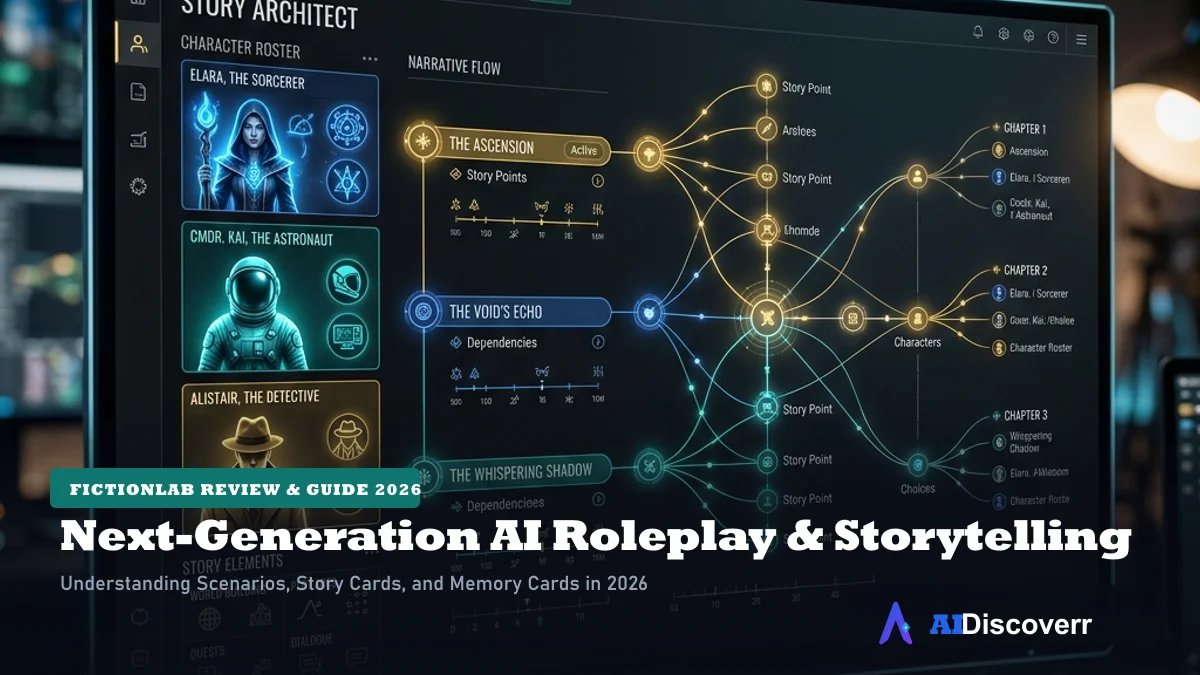
If you're looking for an AI platform built around interactive stories rather than ordinary chatbot conversations, FictionLab is worth a closer look.
FictionLab focuses on scenarios, characters, world-building, and long-form roleplay. Its system includes dedicated Story Cards, Memory Cards, multiple AI models, message editing, branching, and other controls designed for interactive fiction.
The biggest difference from a standard character chatbot is simple: FictionLab is built around the story scenario, not just the character.
Quick Verdict: Is FictionLab Worth Using?
FictionLab is best for users who want detailed AI roleplay, world-building, multi-character scenarios, and more control over how a story develops. It is less ideal for users who only want a simple one-character chatbot or a highly visual AI companion.
Its official documentation shows a broad model lineup, including free and premium models, while its scenario system gives creators control over settings, narrative styles, characters, and user interaction rules.
What Is FictionLab?
FictionLab is an AI-powered interactive storytelling and roleplay platform. Instead of starting with only a character and asking it questions, FictionLab lets users enter or create scenarios.
A scenario can contain:
- A setting
- Characters
- World-building information
- Narrative rules
- Story cards
- User-character details
- Custom AI instructions
The official site provides scenario discovery across genres such as fantasy, horror, romance, science fiction, mystery, historical stories, games, and many other categories. That makes FictionLab closer to an AI-powered interactive fiction platform than a conventional general-purpose chatbot.
How FictionLab Works
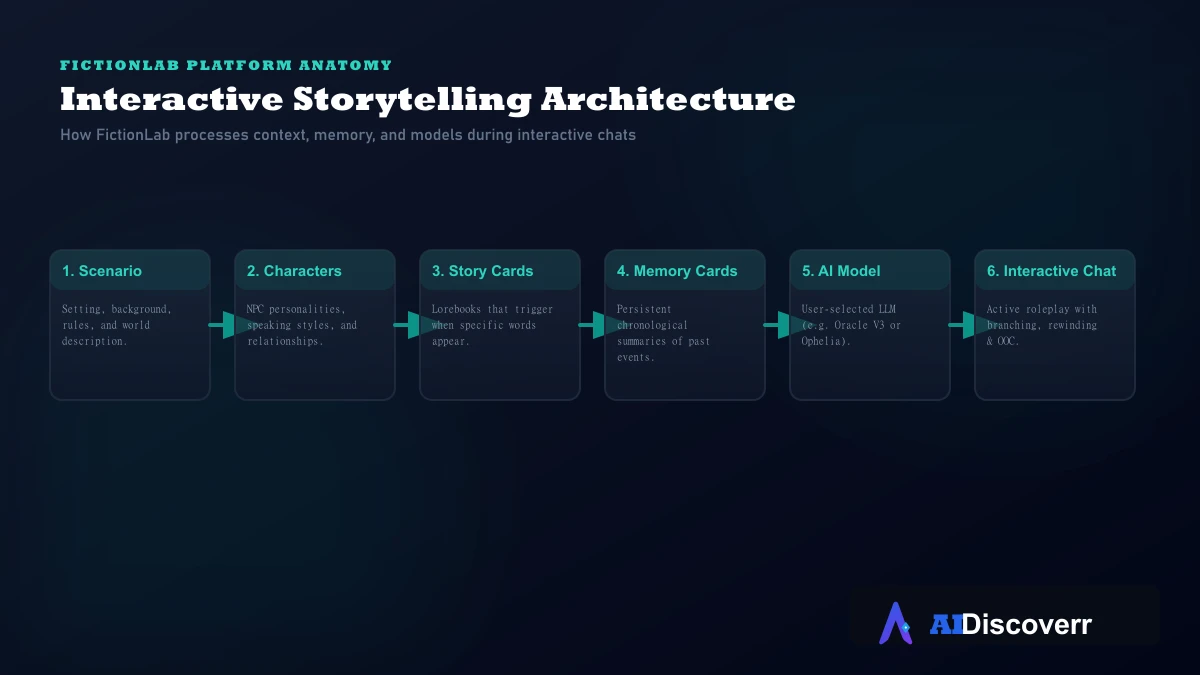
The easiest way to understand FictionLab is to think of it as a digital storytelling framework. Here is the typical flow of interaction:
- Choose a scenario: Explore scenarios created by the FictionLab community or start your own.
- Enter the story: The AI plays the other characters while you control your own character or follow the scenario's setup.
- Choose an AI model: Different models are designed for different writing styles and roleplay needs.
- Continue the story: Write what your character says or does, and the AI responds according to the scenario settings.
- Control the direction: Edit messages, regenerate responses, branch the conversation, or use Out-Of-Character (OOC) commands.
Story Cards vs Memory Cards
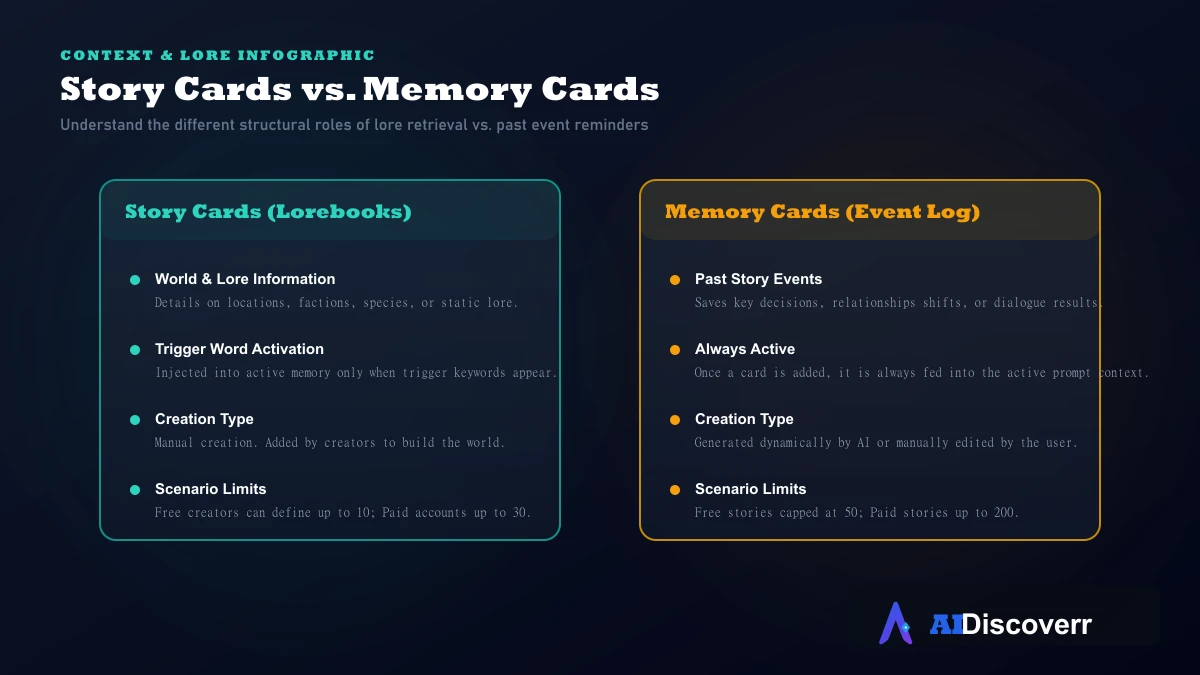
This is one of the most important FictionLab concepts to understand.
| Feature | Story Cards | Memory Cards |
|---|---|---|
| Main purpose | World/lore information | Past events |
| Activation | Trigger words | Always active |
| Best for | Locations, factions, lore | Important story events |
| Automatic generation | No | Yes |
| Free limit | 10 per scenario | 50 |
| FictionLab+ limit | 30 | 200 |
FictionLab's official documentation says Story Cards act like lorebooks. They provide specific information to the AI when their trigger words appear. Memory Cards work more like persistent reminders about events that already happened.
How Do I Make FictionLab Remember Story Details?
This is a common question from roleplayers seeking to avoid "goldfish memory." To ensure details stick, use FictionLab's dual-memory structure:
- Update Memory Cards manually: While the AI creates cards for major events, you can edit them to clarify important plot points, character relations, or key items.
- Create specific Story Cards: Write cards for persistent elements. For example, a card triggered by "cursed dagger" ensures the AI always remembers the dagger's properties when it's mentioned.
- Clean up chat history: Periodic branching or pruning keeps older, irrelevant exchanges from clogging the active model context window.
FictionLab AI Models Explained
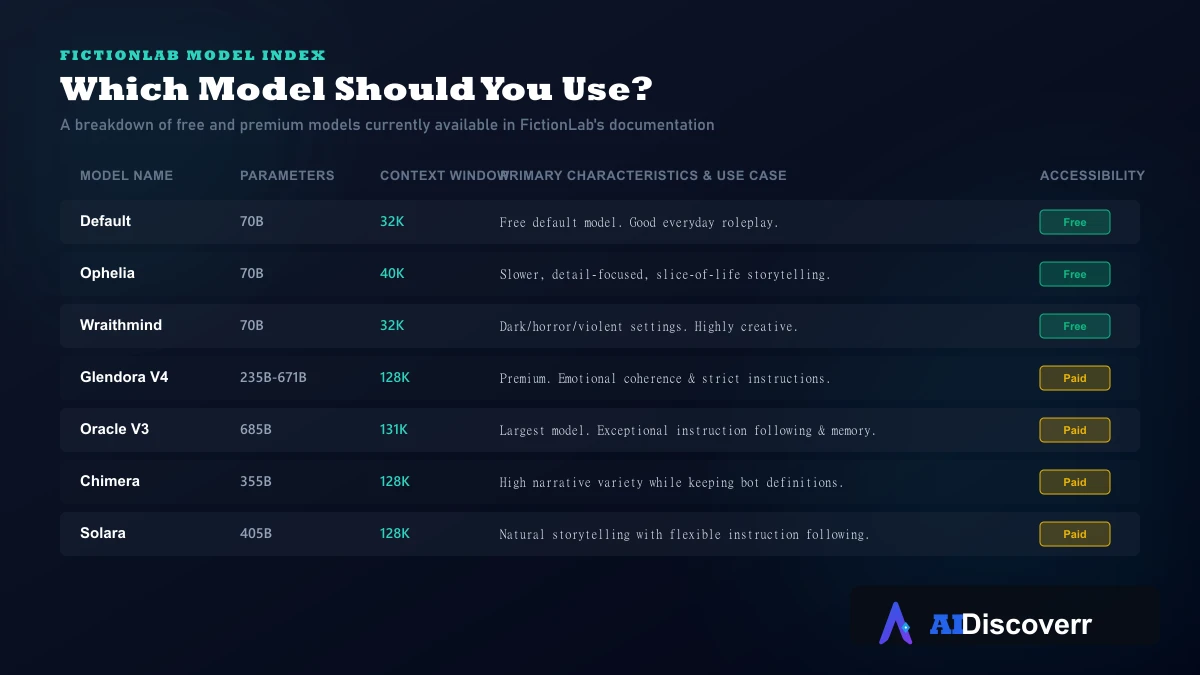
One of FictionLab's strongest features is model selection. The current official documentation lists seven models with distinct characteristics:
Default
The Default model is a 70B model with a 32K context window. FictionLab describes it as its default free model, offering balanced creativity and decent memory performance.
Ophelia
Ophelia is a 70B model with a 40K context window. It is designed for smaller details and slower pacing, making it suitable for slow-burn and slice-of-life roleplays.
Wraithmind
Wraithmind is another 70B model with a 32K context window. FictionLab positions it specifically for darker roleplays, including horror and violent scenarios.
Glendora V4
Glendora V4 is a premium FictionLab+ model listing a 235B–671B parameter range and a 128K context window. It is designed around emotional coherence and strict instruction following.
Oracle V3
Oracle V3 is a flagship model with 685B parameters and a 131K context window. It emphasizes instruction following, memory retrieval, natural responses, and narrative consistency.
Chimera
Chimera is a 355B parameter model with a 128K context window. Its stated focus is adding character variety while keeping interactions aligned with defined profiles.
Solara
Solara is a 405B parameter model with a 128K context window. It represents an evolution of the Sorcerer models, emphasizing creativity alongside natural dialogue styles.
FictionLab Free vs FictionLab+
FictionLab offers a free experience, and its official documentation confirms that free users can use the Default model and have access to core features. The documentation also identifies several higher limits for the paid FictionLab+ tier:
| Feature | Free Tier | FictionLab+ Tier |
|---|---|---|
| User-character slots | 10 | 200 |
| Custom LLM instructions | 300 characters | 1,000 characters |
| Story Cards | 10 | 30 |
| Memory Cards | 50 | 200 |
| Chat backgrounds | 7 | 40+ |
| Custom backgrounds | Not available | Available |
| Premium models | Limited access | Full access |
How to Use FictionLab
Starting a roleplay session on FictionLab takes just a few steps:
- Create an Account: Register on the official platform or Progressive Web App (PWA).
- Choose a Scenario: Search the public directory or start building your own setting.
- Select your Character: Choose your role or define a custom user-character profile.
- Start Chatting: Input your character's first action or reply to the scenario prompt.
- Use OOC Commands: guía the AI by typing instructions inside brackets (e.g.,
[OOC: Describe the room in more detail]). - Edit or Regenerate: If the AI goes off-track, edit its message or regenerate the response.
- Create a Branch: If you want to test a different path, use the branch option from a specific message node.
How to Create Better FictionLab Scenarios
Building a strong scenario requires structured inputs rather than a wall of prose:
- Setting: Define the physical world, its rules, technology or magic systems, and current situation clearly.
- Character Design: Give NPCs distinct personalities, motivations, speech patterns, and historical relationships.
- Custom Instructions: Set the point of view (e.g., third-person limited), writing style, pacing, and formatting rules.
- Incorporate Story Cards: Create cards for important lore items or locations that the AI only needs to read when they are mentioned.
- Maintain Agency: Instruct the AI to focus on describing NPC actions and the environment, leaving the user's decisions to the user.
Does FictionLab Write the User's Actions for Them? (How to Stop It)
A common user complaint on Reddit involves the AI generating actions or dialogue for the user's character, breaking immersion.
To stop the AI from controlling your character, the official FictionLab documentation recommends incorporating explicit boundary instructions into the scenario creator:
"Do not write dialog or actions for the user. Control only NPCs and environment details. Respond dynamically to the user's choices."
You can add this to the scenario's custom instructions, or use a bracketed OOC command (e.g.,[OOC: Do not assume my character's dialogue or thoughts]) to correct the AI mid-story.
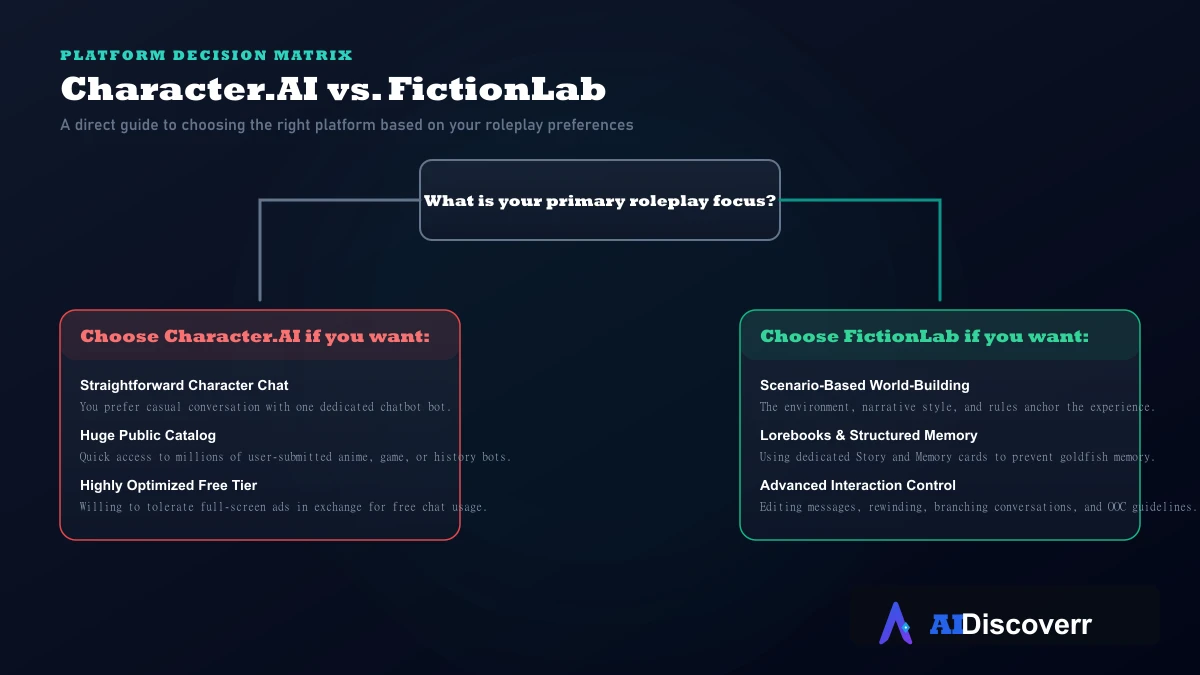
Is FictionLab Good for People Coming From Character.AI?
Many users looking to switch from Character.AI compare the two platforms. While Character.AI is optimized for chatting with individual bots, FictionLab is structured for world-building and narrative tracking.
The table below breaks down the structural differences:
| Feature | FictionLab | Character.AI |
|---|---|---|
| Main focus | Scenario-driven storytelling | Character-based AI chat |
| World-building | Strong (Story Cards & Settings) | Limited options |
| Memory structure | Story Cards & Memory Cards | Standard context length |
| AI Model selection | Multiple choices (Oracle, Ophelia, etc.) | Single default model per tier |
| Branching paths | Yes (Direct message nodes) | Varies by client version |
If you want simple, quick conversations with popular characters, Character.AI is highly accessible. If you prefer building detailed story worlds with stable memory, FictionLab is a much stronger alternative.
FictionLab Pros and Cons
FictionLab Pros and Cons
Evaluating the platform's strengths and limitations for interactive storytelling.
Where It Shines
Scenario-based storytelling
The story setting and narrative rules guide the AI effectively.
Advanced memory tools
Story Cards (lorebooks) and Memory Cards prevent context loss.
Granular controls
Message editing, regeneration, branching, and OOC commands.
Model selection
Seven distinct AI models optimized for different storytelling styles.
PWA access
Works across desktop and mobile browsers without App Store filters.
Where It Falls Short
Learning curve
Structuring scenarios and managing cards takes initial effort.
Repetitive text
Some models can fall into repetitive dialogue patterns.
Verification requirements
Privacy settings and account verification vary.
Pricing transparency
Subscription limits and rates are subject to change.
Is FictionLab Worth Paying For?
For serious writers and roleplayers, FictionLab+ is worth considering. The ability to define up to 30 Story Cards and 200 Memory Cards solves the memory limitations common on other platforms.
For casual users who roleplay occasionally, the free tier is sufficient to explore public scenarios. We recommend testing the Default model on the free plan before subscribing.
Is FictionLab Safe and Private?
When evaluating safety, avoid assuming total privacy. FictionLab's Google Play listing reports that data is encrypted in transit and users can request deletion. However, personal information and conversation logs may be collected. Read the platform's privacy policy directly before entering sensitive or personal details.
FictionLab Alternatives
If FictionLab doesn't fit your needs, consider these alternatives:
- Character.AI review: Best for character discovery and straightforward chat.
- DreamGen AI review: A strong option for advanced steering controls and uncensored storytelling.
- Nomi AI review: Best if you prefer individual companion relationships and emotional support.
- Janitor AI: Popular for flexible roleplay using user-supplied models.
- KoboldAI: Best for self-hosted or technical model controls.
Frequently Asked Questions
What is FictionLab AI?
FictionLab is an AI-powered interactive storytelling and roleplay platform built around scenarios, characters, world-building, and AI-generated conversations.
Is FictionLab free?
Yes. FictionLab provides a free tier with access to its Default 70B model and core roleplay functionality including editing and regeneration.
Does FictionLab have memory?
Yes. FictionLab has dedicated Memory Cards designed to preserve important events from previous parts of a roleplay alongside permanent Story Cards for lore.
What are FictionLab Story Cards?
Story Cards are lorebook-style entries that provide the AI with information when their trigger words appear in the conversation.
What AI models does FictionLab use?
The current official documentation lists Default, Ophelia, Wraithmind, Glendora V4, Oracle V3, Chimera, and Solara.
Can you edit FictionLab responses?
Yes. FictionLab allows users to edit messages and regenerate responses to direct the narrative flow.
Can you branch a FictionLab story?
Yes. Chat branching allows users to create another story path from an earlier point in the conversation.
Is FictionLab better than Character.AI?
It depends on your goal. FictionLab is particularly attractive if you want scenario-based storytelling and world-building. Character.AI may be preferable if your main priority is character discovery and straightforward character chat.
Is FictionLab worth paying for?
It depends on how heavily you use it. Casual users may find the free tier sufficient, while frequent roleplayers may benefit from FictionLab+'s higher limits and premium models.
Editorial review. Not affiliated with FictionLab. Features and pricing are subject to change — confirm details on official channels before subscribing.
Lead AI Tech Analyst & Editorial Director