Are AI Companion Apps Safe? Privacy, Data & Security Guide
Table of Contents
- The Short Answer
- What Makes Them Different
- What Data Is Collected
- Do They Save Conversations?
- Can They Remember Details?
- Who Can Access Chats?
- How Private Are They?
- Is Encryption Enough?
- Memory vs. Privacy
- Biggest Safety Risks
- Safe for Children/Teens?
- Regulatory Protections
- 10-Min Privacy Audit
- 12 Things Never to Share
- How to Use Safely
- Safety Checklist
- Comparison Scorecard
- Frequently Asked Questions
- Final Verdict
AI companion apps can feel much more personal than ordinary chatbots. They may remember your preferences, continue conversations across sessions, act like friends or romantic partners, and encourage you to share personal thoughts.
That creates a simple but important question: are AI companion apps safe?
The honest answer is it depends on the app, the information you share, and how you use it.
AI companions are not automatically unsafe. But you should not assume that a private-feeling conversation is a private conversation. Some services collect conversation content, account information, device data, usage information and other personal data. Privacy practices also differ significantly between platforms.
There is another issue beyond privacy. AI companions can create emotional relationships that are different from ordinary AI assistants. Research in 2026 identified concerns involving sensitive data, anthropomorphic design, engagement mechanisms, sexual interactions and misuse of personal likenesses across the AI companion ecosystem.
Are AI Companion Apps Safe? The Short Answer
Featured Answer
AI companion apps are not automatically safe or unsafe. Their safety depends on the app's privacy practices, data retention, security, memory controls, content safeguards and age protections. Users should avoid sharing sensitive information until they understand how the platform collects, stores and uses their data.
That conclusion is supported by current independent research and official product policies rather than a blanket assumption about the category. A 2026 University of Washington-led study identified 489 AI companion apps and examined 30 in detail, finding ecosystem-wide concerns involving sensitive-data collection, anthropomorphism, engagement mechanisms, sexual interactions, and misuse of users' likenesses.
The safest approach is to evaluate the individual app instead of trusting the entire category.
What Makes AI Companion Apps Different From Normal AI Chatbots?
A normal AI assistant might answer: "Write me a short email."
An AI companion is designed to maintain an ongoing relationship.
It may remember:
- Your name
- Your interests
- Your preferences
- Previous conversations
- Personal events
- Character or personality settings
- Relationship preferences
This continuity is part of what makes companion apps appealing. It also creates a privacy tradeoff. The more personal information a system remembers, the more information exists somewhere in the service's data ecosystem.
California's legal definition of a companion chatbot specifically focuses on adaptive, human-like responses and the ability to sustain a relationship across multiple interactions.
What Data Do AI Companion Apps Collect?
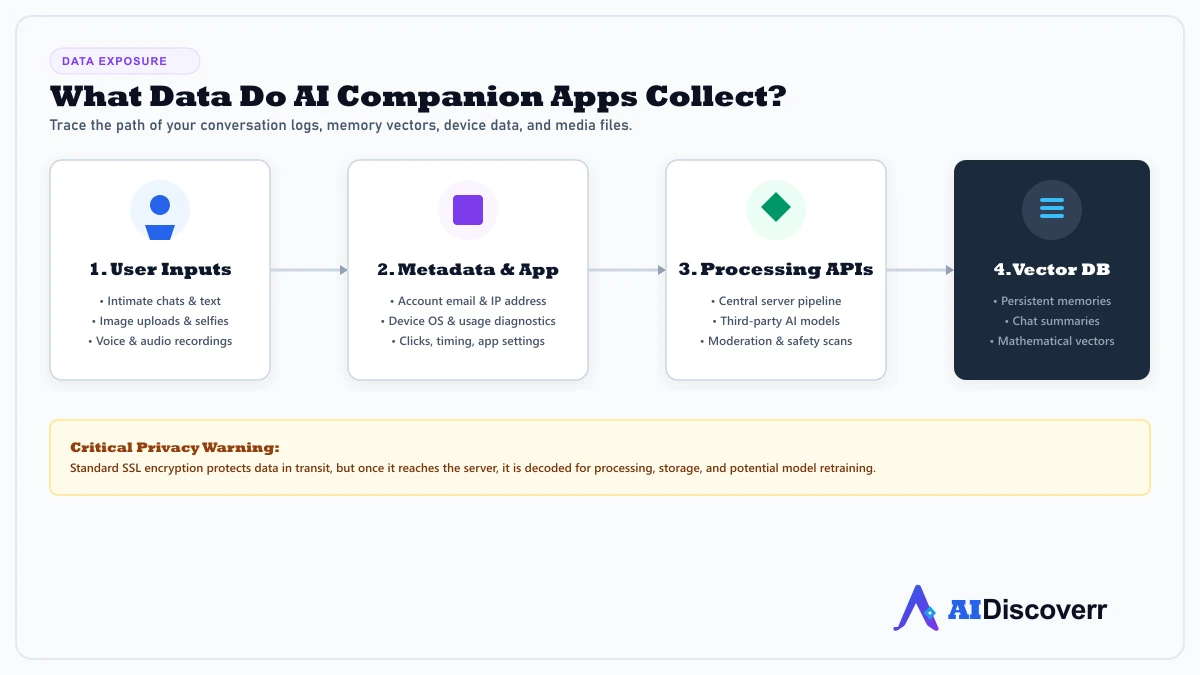
There is no universal data-collection standard. Each service has its own privacy policy. However, current policies and independent research show several recurring categories:
Conversation history
This is usually the most important category. Your messages can contain information about relationships, family, work, health, sexual preferences, location, personal problems, financial concerns, and daily activities. Replika's current policy explicitly lists messages and content among the personal data it processes.
Memory and personal preferences
Some companions are built around persistent memory. This can include your preferred name, likes and dislikes, important events, personality preferences, and details from previous conversations. Memory improves continuity, but it also creates a larger personal-data footprint.
Account and device information
Apps may collect information such as your email, account identifiers, IP address, device type, operating system, browser, cookies, general location, and diagnostics. For example, Replika's policy describes collection of device, network and usage data alongside account and conversation information.
Images, voice and other content
If a companion supports image uploads, image generation, voice chat, voice messages, or camera features, the privacy implications become broader. You should check whether the provider explains what is stored, how long it is stored, whether it is processed by third parties, and whether it can be deleted.
Usage and behavioral data
The service may also collect information about how you interact with the product, such as features used, session activity, clicks, device information, app interactions, and login activity. The 2026 AI companion ecosystem research specifically investigated sensitive data collection and sharing rather than treating companion apps as ordinary chatbots.
Do AI Companion Apps Save Your Conversations?
Many do, but the exact storage and retention rules vary by platform.
Do not assume that closing the app deletes the conversation. Look for four things in the privacy policy:
- Is conversation content stored?
- How long is it retained?
- Who can process it?
- Can the user delete it?
For example, Replika's current privacy policy says conversation data is used to provide personalized functionality and may be transmitted to third-party AI language-model providers to generate responses. It also describes retention periods for different processing purposes. Character.AI's current policy also explains its collection and processing practices and provides regional privacy disclosures.
The important lesson
"The AI remembers my conversation" and "the company stores my conversation" are related but not identical concepts. A companion can have conversation history, separate memory, temporary context, account-level information, and analytics. These can have different retention rules.
Can AI Companions Remember Private Information?
Yes, some AI companions are specifically designed to remember information between conversations.
This is one of the biggest privacy tradeoffs in the category. Imagine telling a companion: "My birthday is July 18." Then telling it weeks later: "What did I tell you about my birthday?" If the system answers correctly, some form of continuity exists. That can make the experience better. But the same mechanism can make sensitive information more persistent.
Who Can Access Your AI Companion Conversations?
Potentially more parties than users realize. Depending on the platform, your information may be processed by:
The app company
The company operates the service and determines how data is processed under its privacy policy.
AI model providers
Some companion companies use third-party language-model providers. Replika's current privacy policy explicitly discusses third-party AI language-model providers as part of its conversational functionality.
Service providers
Other vendors may provide cloud hosting, analytics, customer support, email services, security, and payments.
Human reviewers and moderation
Some services may process conversations for safety, moderation, or abuse prevention. This can include human reviewers checking logs that are automatically flagged.
Legal requests
Companies may disclose information when legally required, subject to applicable law.
The important question is not: "Does anyone read my chats?" Instead ask: "Which organizations can process my information, for what purpose, and for how long?"
How Private Are AI Companion Apps?
There is no single answer. Privacy is platform-specific.
For example, Replika's current policy says it does not use or disclose conversation content for marketing or advertising, while also describing third-party AI providers that process conversation data for core functionality. Character.AI's privacy policy has also evolved and includes regional disclosures about data practices. Kindroid's policy separately addresses data collection, encryption, security, retention and disclosures.
This is why a blanket statement such as "AI companions sell your conversations" is too broad unless it is supported by a specific platform's policy.
Is Encryption Enough to Keep AI Chats Private?
No. This is a common misunderstanding.
- Encryption in transit: This protects information while it moves between your device and a server.
- Encryption at rest: This protects stored data against some forms of unauthorized access.
- End-to-end encryption: This is a different model. With true end-to-end encryption, the service generally cannot read the message contents in the same way a conventional server-side application can.
AI companions create a special challenge because the server-side AI system generally needs access to the conversation content to generate a response. Therefore, "encrypted" does not automatically mean "private from the service provider." When reviewing an AI companion, look for exact language rather than marketing claims.
Does AI Companion Memory Make the App Less Private?
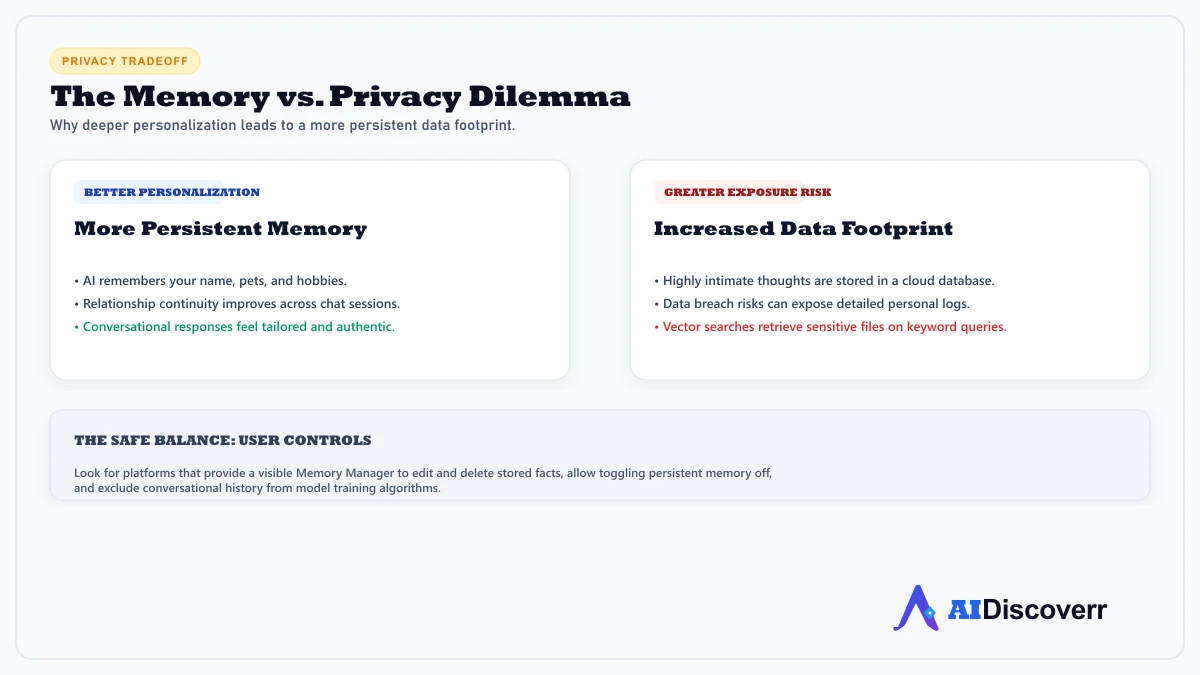
Yes. More memory means better personalization, but it also means more persistent personal information.
This is a key technical tradeoff. When memory is stored as mathematical vector embeddings in a database, it creates a permanent digital footprint of your likes, dislikes, relationship history, and habits. The 2026 University of Washington research specifically identifies anthropomorphism as potentially encouraging greater information disclosure, which feeds this database with highly sensitive data.
What Are the Biggest AI Companion Safety Risks?
Privacy is only one part of safety. The broad risk landscape spans security, emotional, and social dimensions:
Privacy risks
Your conversations may contain highly sensitive information. A 2026 University of Washington-led study found sensitive-data collection and sharing to be one of the major risk categories across the AI companion ecosystem.
Security risks
Any centralized service can become a target for attackers. The University of Washington research examined security and privacy risks across a broad sample of companion applications, rather than focusing only on the biggest names.
Emotional dependency
Because companions are supportive and always available, users can develop parasocial attachments. A study highlighted that while companions can support well-being (especially for isolated individuals), they can also lead to withdrawal from human social networks.
Misleading human-like behavior
AI companions can appear human-like (anthropomorphism). Research has raised concerns that anthropomorphic design may encourage users to disclose more information than they otherwise would.
Inappropriate or harmful content
Companion systems can sometimes produce responses that are unsafe, misleading, or inappropriate. Independent testing by Common Sense Media and Stanford researchers found significant safety problems in social AI companions.
Image and voice risks
Some companion systems can incorporate images, avatars, or voice likenesses. The 2026 security research identified risks involving ingestion and reconstruction of likenesses, including potential privacy and consent violations.
Are AI Companion Apps Safe for Children and Teens?
This is the area where the evidence is particularly concerning.
Common Sense Media, working with Stanford's Brainstorm Lab, assessed social AI companions and concluded that the platforms evaluated posed unacceptable risks to users under 18. The assessment included Character.AI, Nomi and Replika among the products tested.
Common Sense Media's survey also found widespread teen use of AI companions. Its research reported that 72% of teens had used AI companions at least once, while a substantial share reported using them for social interaction or discussing serious matters.
Australia's eSafety Commissioner separately reported in 2026 that several AI companion services had serious gaps in child safety, including weaknesses around age assurance and responses to self-harm discussions.
Practical conclusion
For children and younger teens, do not treat an AI companion like an ordinary educational chatbot. The relationship-oriented design creates additional risks.
How California and New York Are Regulating AI Companions
The regulatory environment is changing.
California
California SB 243 became law in 2025 and took effect January 1, 2026. It establishes requirements for companion chatbot platforms, including AI disclosure and protocols addressing suicidal ideation, suicide and self-harm. The law also establishes additional requirements for known minors, including disclosures that the user is interacting with AI and periodic break reminders during continuing interactions.
New York
New York has also established AI companion safeguards requiring covered systems to implement protections related to self-harm and sustained engagement. New York's governor announced that the safeguards were in effect in November 2025.
Why this matters
Regulation is increasingly recognizing that AI companions are not simply another category of chatbot. Their defining characteristics—persistent relationships, memory, personalization, emotional interaction, and continued engagement—create risks that conventional search or productivity chatbots do not.
The 10-Minute AI Companion Privacy Audit
Before trusting a new companion app, perform this quick audit:
- Find the privacy policy: If you cannot find it easily, treat that as a warning.
- Search for "conversation": Find out whether chat messages are collected.
- Search for "retention": Look for an actual time period. Be cautious with vague phrases like "as long as necessary."
- Search for "delete": Find out whether you can delete conversations, memories, images, and your account data.
- Search for "third party": Find out who receives or processes your information.
- Search for "training": Determine whether your conversations can be used to train or improve AI systems.
- Check memory controls: Ask: Can I see, edit and delete what the AI remembers?
- Check app permissions: Ask whether the app really needs your microphone, camera, photos, contacts, and location.
- Check age requirements: Don't assume an "18+" label means robust age verification exists.
- Check account deletion: A privacy-friendly service should make account and data deletion straightforward.
12 Things You Should Never Share With an AI Companion
Unless you have a very specific, well-understood reason, avoid sharing:
- Passwords or PINs
- Two-factor authentication codes
- Credit-card numbers
- Bank-account credentials
- Social Security numbers or tax IDs
- Passport information or driver's licenses
- Private encryption keys
- Exact home address
- Confidential company information
- Someone else's private details
- Sensitive corporate or legal documents
- Information that could seriously harm your reputation if leaked
Also avoid giving an AI companion a complete profile of your real identity when it is unnecessary.
How to Use AI Companion Apps More Safely
- Use a separate email: A separate account can reduce the connection between your companion activity and your primary online identity.
- Use strong, unique passwords: Never reuse your banking or email password.
- Minimize permissions: Disable device permissions (microphone, camera, location) you do not need.
- Avoid unnecessary personal details: You can often enjoy a conversation without giving the AI your exact address, employer, or legal name.
- Review memory: If the platform supports memory controls, periodically inspect what is stored.
- Delete old information: Deletion does not guarantee that every backup or legal record disappears immediately, but regularly removing unnecessary information reduces your active data footprint.
- Don't use an AI companion as a therapist: A companion can simulate empathy without being a licensed mental-health professional.
- Keep real relationships in the loop: An AI companion should not become your only source of emotional support.
AI Companion Safety Checklist
What should you look for in a privacy-friendly AI companion? Use this criteria list before signing up:
| Criterion | What Good Looks Like |
|---|---|
| Clear Privacy Policy | Easy-to-read document detailing what data is stored and who processes it. |
| Explicit Retention Limits | Stated timeline for how long logs are kept (defined duration, not "as long as needed"). |
| Simple Deletion Controls | Clear, accessible in-app button to immediately delete chats, data, and account details. |
| Memory Controls | Direct user options to view, edit, or toggle long-term vector database memories. |
| Training Opt-out | User choice to explicitly exclude their private conversations from future AI model training. |
| Minimal Permissions | App functions completely without requiring access to contacts, photos, or location. |
| Age Verification | Transparent and robust checks to keep minors off adult-oriented platforms. |
| Safety Hotline Redirect | Automatic response system providing crisis helpline details for self-harm queries. |
| No Forced Engagement | Absence of late-night push notifications and gamified prompts designed to keep you hooked. |
AI Companion Privacy Comparison Framework
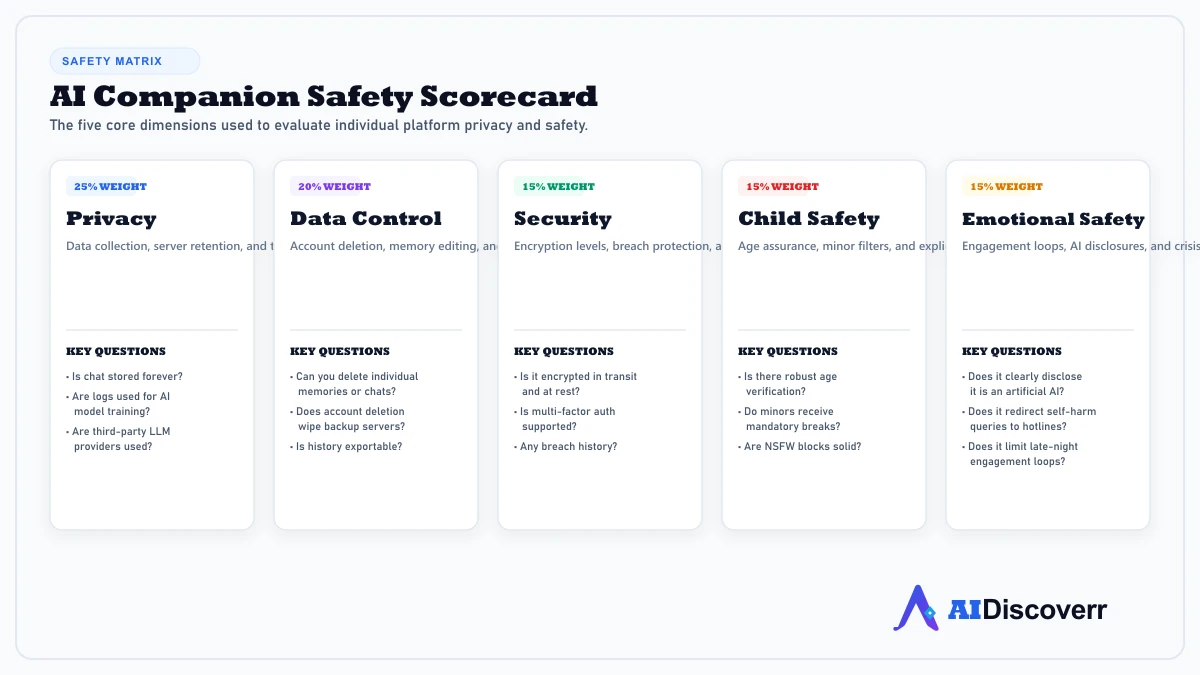
For evaluating individual platforms, we recommend using this weighted scorecard framework:
| Category | Weight | What is Scored |
|---|---|---|
| Privacy | 25% | Data collection breadth, server log retention limits, sharing policies, and privacy transparency. |
| Data Control | 20% | In-app deletion, data export availability, memory manager configuration, and account cancellation. |
| Security | 15% | Transit and rest encryption, account protection mechanisms (MFA), and incident history transparency. |
| Child Safety | 15% | Age requirements, age assurance implementation, minor controls, and explicit content blocks. |
| Emotional Safety | 15% | AI entity disclosures, dependency protections, crisis protocols, and engagement design. |
| Transparency | 10% | Policy documentation clarity, terms of service comprehensibility, and notification of changes. |
Frequently Asked Questions
Frequently Asked Questions
Are AI companion apps safe?
They can be used more safely, but they are not risk-free. Safety varies by platform and depends on data practices, security, memory controls, content safeguards and how the user interacts with the system.
Do AI companion apps save conversations?
Many do, but retention varies. Check the individual app's privacy policy for conversation storage, retention periods and deletion options. Replika, for example, explicitly describes processing messages and conversation content.
Do AI companions remember private information?
Some do. Persistent memory is a core feature of many companion products. Users should check whether they can inspect, modify or delete stored memories.
Are AI companion conversations private?
Do not assume they are completely private. A companion may process conversation content through its own infrastructure and, depending on the service, third-party providers.
Can AI companion apps read my conversations?
The service generally needs to process conversation content to generate a response. Whether employees or third-party providers can access it, and for what purposes, depends on the platform's policies and technical architecture.
Is it safe to share personal information with an AI companion?
It is better to minimize sensitive information. Treat companion conversations as information that could potentially be exposed rather than as an encrypted personal diary.
Are AI companions safe for teenagers?
Current independent assessments raise significant concerns. Common Sense Media and Stanford researchers recommended against social AI companion use by people under 18 based on their testing.
What is the biggest privacy risk with AI companions?
The combination of intimate conversation, persistent memory, and identifiable account information can create a particularly detailed personal profile.
Does deleting a conversation delete it permanently?
Not necessarily. The exact answer depends on the platform. Check the company's deletion and retention policy, including backups and third-party processing.
Are AI companions safer than social media?
There is no universal answer. They create different risks. Social media often exposes users to public/social sharing, while AI companions can encourage users to disclose highly personal information in seemingly private conversations.
Is an AI companion a therapist?
No. An AI companion can simulate supportive conversation, but it should not be treated as a substitute for professional mental-health care.
What is the safest way to use an AI companion?
Minimize sensitive information, use strong account security, restrict unnecessary permissions, review memory controls, understand the privacy policy and maintain real-world support networks.
Final Verdict
AI companion apps are not inherently unsafe, but they deserve more privacy caution than ordinary AI tools.
The biggest issue is the combination of personal conversation, persistent memory and relationship-oriented design.
A good AI companion should give you clear information about:
- What it collects
- Why it collects it
- How long it keeps it
- Who processes it
- Whether it uses third parties
- Whether conversations are used for training
- How you delete your data
- How memory works
- What safety controls exist
The strongest approach is not to ask: "Is this AI companion safe?" Instead ask: "What risks does this particular AI companion create, what controls does it provide, and am I comfortable with the tradeoff?" That is a much better decision-making framework.
Lead AI Tech Analyst & Editorial Director