DreamGen AI Review 2026 — Pricing, Features, and Is It Worth It?
Table of Contents

You're twenty-five messages into a story. Your morally grey assassin, cold, calculating, speaks in short sentences, suddenly starts rambling philosophically. The villain you built as charismatic and soft-spoken turns loud and threatening for no reason.
This isn't a DreamGen bug. It's how every large language model works once a conversation outgrows its context window, and DreamGen is honest about facing the same limitation every competitor does. What makes this platform worth a closer look is how much control it gives you to fight back against that drift, and how clearly it draws its own content boundaries.
This review covers what DreamGen actually does well as a narrative-first roleplay platform, how its credit-based pricing really works, and the specific technique serious users rely on to keep long stories coherent. No inflated claims. Just what the evidence shows.
What Is DreamGen?
DreamGen is an AI-powered roleplay and interactive story-writing platform built by a small, bootstrapped team focused on generative fiction. It positions itself differently from most AI companion apps: rather than a single ongoing chat with one character, DreamGen calls itself a narrative partner, built around world-building, multi-character scenes, and steerable plot direction.
The platform runs on a sleek, chat-like interface but underneath supports genuinely complex features: a "Codex" system for tracking lore and characters, an "Anchors" field for pinning key facts the AI should never forget, and a "Steering" dial that lets you nudge a scene's tone mid-response rather than rewriting prompts to fix drift after the fact. A major V2 interface overhaul shipped in March 2026, addressing earlier complaints about scenario management and adding visible memory controls.
DreamGen offers two core modes, and understanding the difference matters more than most reviews explain.
Story Mode vs. Roleplay Mode — What's the Difference?
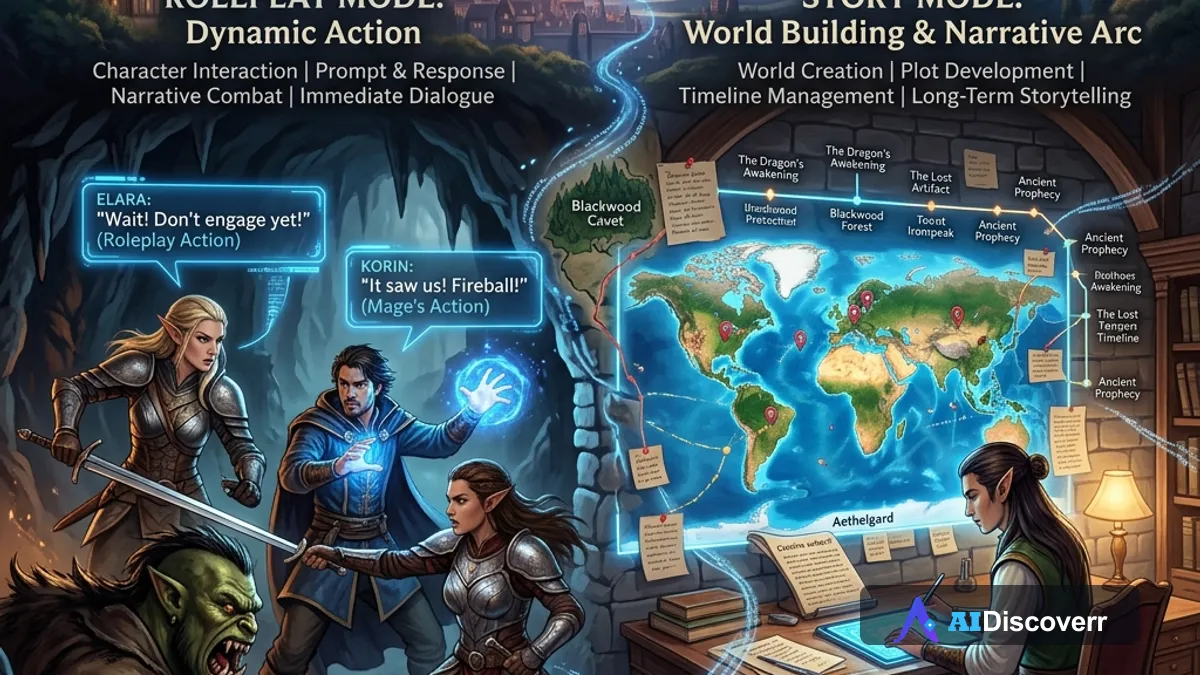
Roleplay Mode functions closer to a traditional AI companion chat: you interact in real time with one or more characters, driving the scene turn by turn, similar to what you'd expect from Character.AI or Candy AI, but with DreamGen's deeper lore and steering tools layered on top.
Story Mode is built for long-form fiction writing rather than live back-and-forth interaction. You can generate extended narrative passages, guide plot direction at a higher level, and use the platform more like a collaborative co-writer than a chat partner. Writers working on novel-length projects tend to lean on Story Mode specifically because it's designed to sustain a coherent arc across many scenes, not just one conversation.
Most disappointment with DreamGen, per multiple independent reviews, traces back to picking the wrong mode for what you actually wanted: users expecting a simple companion chat experience find Roleplay Mode has more of a learning curve than competitors, while users expecting deep narrative control specifically want Story Mode and its Codex system.
Is DreamGen Free?
Yes, and the free tier is genuinely usable, not just a locked demo. You get a 4,000-token context window with no credit card required, enough to test both Story and Roleplay modes and get a real sense of whether the platform's approach fits how you want to write or play.
The honest limitation: the free tier's smaller context window and capped daily generation mean the long, coherent sessions DreamGen is actually known for aren't fully achievable without upgrading. Expect to burn through a free evening's allowance faster than you might expect if you're testing seriously.
DreamGen Pricing — How the Credit System Actually Works
DreamGen uses a credit-based system across three paid tiers, on top of the free plan.
| Plan | Context Window | Price |
|---|---|---|
| Free | 4,000 tokens | $0 |
| Starter | Mid-size context | Around $7.83-8/month |
| Advanced | Larger context | Around $19.35/month |
| Pro | 30,000 tokens | Around $48.30/month |
Credits are consumed differently depending on which model you use. Smaller, faster models cost roughly 0.033 credits per 1,000 input tokens and 0.1 credits per 1,000 output tokens. Larger, more capable models cost roughly ten times as much, around 0.33 credits per 1,000 input tokens and 1.0 credit per 1,000 output tokens. Monthly credits reset at the start of each billing cycle, and daily bonus credits kick in if you exhaust your monthly allowance, giving you a smaller ongoing allotment rather than being fully locked out.
Practical guidance: if you're a casual user who roleplays occasionally, the free tier or Starter plan covers you. If you're writing long, detailed multi-character scenes regularly, budget for Advanced or Pro, since heavier models consume credits roughly ten times faster than lighter ones.
What's DreamGen's Content Policy? Is It Actually Unfiltered?
This is worth answering precisely, since "no rules, no restrictions" marketing language can be misleading if taken completely literally.
DreamGen permits private, adult-themed content for verified users 18 and older. It explicitly and strictly prohibits child sexual abuse material, non-consensual deepfakes of real people, and public sharing of adult-rated content generated on the platform. This creates what's best described as a "private, uncensored" model, meaningfully more flexible than Character.AI's filtering, but with clear, stated, enforced boundaries, not an unmoderated free-for-all.
That distinction matters. A platform that states and enforces real content boundaries, even a permissive one, is a fundamentally different trust proposition than one with no stated policy at all.
DreamGen's AI Models Explained
DreamGen offers multiple model tiers, generally described as smaller/faster models and larger/more capable models, with naming that has evolved across 2026 platform updates (some sources reference "Lucid Base" and "Lucid Max," reflecting the current model lineup). Larger models produce more coherent, higher-quality prose and better multi-character consistency, at a meaningfully higher credit cost per message.
For casual roleplay, smaller models are often sufficient and preserve your credit balance. For serious long-form fiction where prose quality and character consistency matter most, the larger model tier is where DreamGen's narrative strength genuinely shows.
Why Does My DreamGen Character Start Acting Different After 20 Messages?
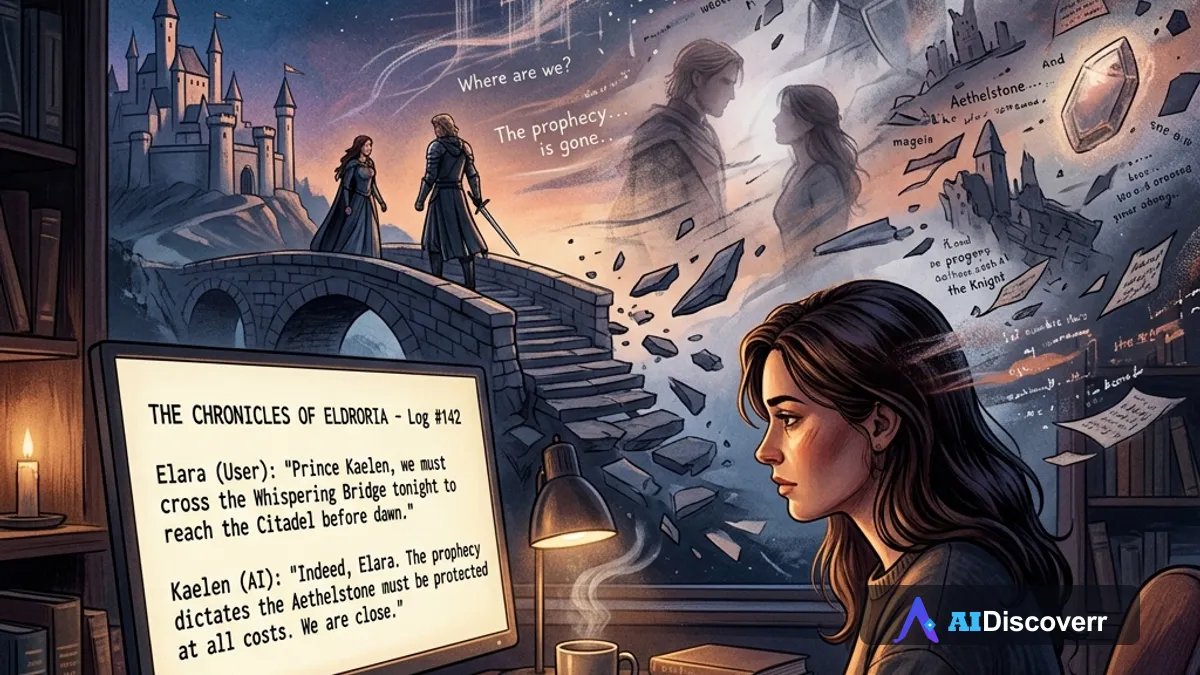
This is DreamGen's most consistently reported limitation, and every credible review covers it honestly rather than hiding it: context drift. As a conversation grows longer, earlier details slide out of the model's active context window. Characters forget inventory items, relationships quietly reset, and established plot details vanish without explanation, even on the Pro plan's larger 30,000-token window. It happens slower on higher tiers, but it isn't eliminated.
This isn't unique to DreamGen; it's a fundamental characteristic of how large language models handle long conversations. What sets DreamGen apart is that experienced users have developed a specific, effective workaround, and DreamGen's own tools support it directly.
The "Story Bible" technique, step by step:
- Every five scenes or so, pause your roleplay or story session.
- Summarize the current state in third person: character relationships, key items, unresolved plot threads. For example: "Elena now trusts the protagonist after the cave rescue. The cursed dagger remains hidden in the protagonist's boot. The antagonist believes Elena is dead."
- Paste this summary into DreamGen's Anchors or Lore field, or prepend it directly to your next message as a recap block.
- Trim older message history from the active context window, keeping only your most recent few exchanges plus the Story Bible summary.

This isn't a perfect fix, it's manual maintenance, not a background feature, but it's a genuinely effective, repeatable technique that turns an unavoidable technical limitation into something manageable rather than a dealbreaker.
Does DreamGen Work with SillyTavern?
Yes. DreamGen is officially supported in SillyTavern as a text-completion API backend, making it a popular choice among advanced roleplay and world-building users who prefer working inside their own customized front-end interface rather than DreamGen's native web app. This is a genuine power-user feature most companion-app competitors don't offer at all.
Can I Use DreamGen on Mobile?
It runs in a mobile browser and is functional, but the interface and overall experience are designed primarily for desktop use. If you're doing serious long-form writing or detailed world-building, expect a better experience on a larger screen.
How Do I Cancel My DreamGen Subscription?
Cancellation is handled through your account settings under Billing. DreamGen's own team has noted that you can cancel immediately after subscribing if you want to try a paid tier risk-free, your access continues through the end of the billing period you already paid for rather than being cut off immediately.
DreamGen vs Other AI Roleplay Platforms
DreamGen vs Character.AI
Character.AI offers a much larger free character library and a more polished, beginner-friendly chat experience. DreamGen offers deeper narrative control, multi-character scene management, and a more permissive content policy, at the cost of a real learning curve Character.AI doesn't have.
DreamGen vs NovelAI
NovelAI is a more technically demanding platform aimed at users comfortable with fine-tuning generation settings directly. DreamGen sits between Character.AI's guardrails and NovelAI's technical depth, offering more narrative structure than Character.AI without NovelAI's steeper technical requirements.
DreamGen vs Candy AI
Candy AI focuses on visual companion experiences with strong image and video generation. DreamGen focuses on text-based narrative depth and world-building; if visual content matters most to you, Candy AI is the stronger fit, but DreamGen's Codex and Steering tools have no real equivalent on Candy AI.
DreamGen vs DreamGF
DreamGF simplifies world-building down to a quick visual character creator and delivers stable, low-maintenance companion roleplay at a lower price point. If you want DreamGen's narrative depth without the setup and manual context management, DreamGF is the more pragmatic, lower-effort pick, though it doesn't match DreamGen's multi-character story capability.
DreamGen vs OurDream AI
OurDream emphasizes multi-modal interaction (image generation, calls, community contests) alongside chat, but independent testing reports its content-moderation controls behaving inconsistently against its own stated settings. DreamGen's content policy is more clearly and consistently enforced by comparison.
DreamGen vs FictionLab
FictionLab shares a focus on scenario-based AI storytelling and lorebooks (referred to as Story Cards), but organizes them inside a structured story/character framework. While DreamGen provides more low-level steering and custom AI options, FictionLab offers a more streamlined, user-friendly scenario flow.
DreamGen vs HammerAI
Both DreamGen and HammerAI appeal to advanced roleplayers who want control over their AI models. DreamGen operates as a cloud service with highly customizable writing tools and raw model steering. HammerAI, in comparison, is optimized for running models locally on desktop computers for complete privacy.
DreamGen Pros and Cons
Where It Shines
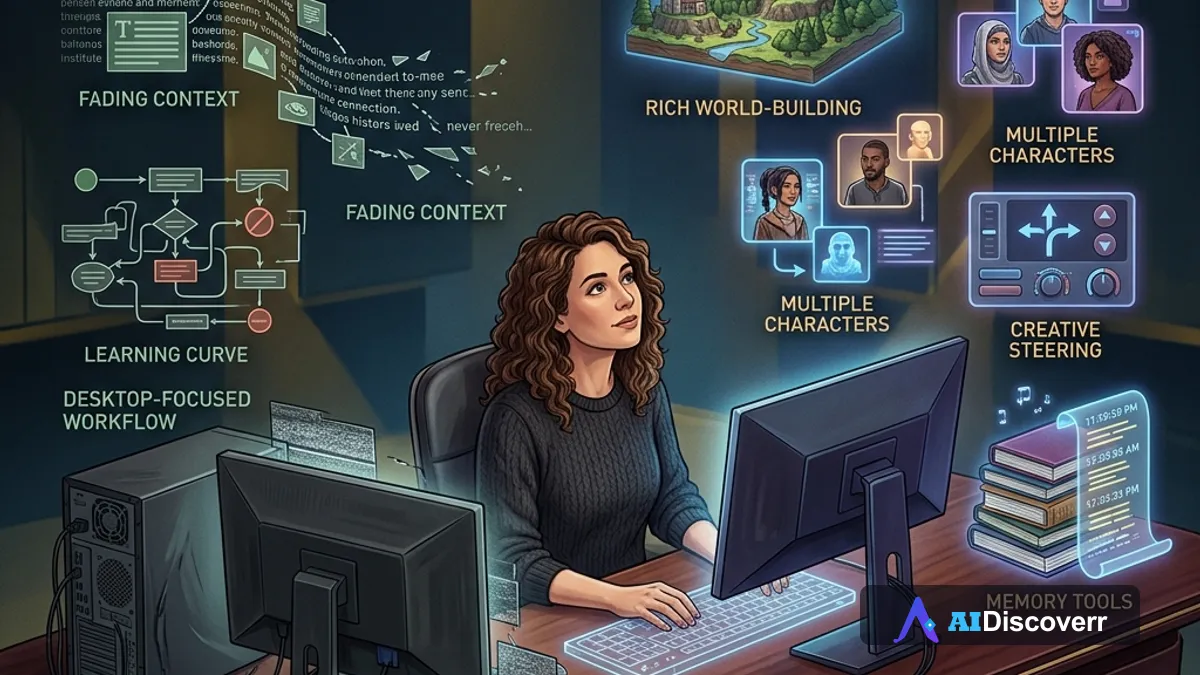
Genuinely deep narrative control: Codex, Anchors, and Steering tools go well beyond basic chat
Generous free tier with no credit card required to start testing
Clear, stated, and enforced content policy, explicitly prohibiting CSAM and non-consensual deepfakes
Official SillyTavern integration for power users who prefer a custom front end
Active developer presence in Discord and Reddit, with a real, shipped V2 update addressing prior complaints
Where It Falls Short
Context drift after 20-30 messages remains a real limitation, even on the Pro plan
Requires manual maintenance (the Story Bible technique) to sustain long, coherent sessions
Real learning curve compared to simpler tap-and-chat competitors
Mobile experience is functional but clearly secondary to desktop
Small, bootstrapped team means feature development can be slower than VC-backed competitors
Reported pricing figures vary slightly across sources, worth confirming directly before subscribing
Is DreamGen Worth It?
If you're a writer or roleplay enthusiast who wants real narrative control, multi-character consistency, and are willing to invest a bit of setup effort, DreamGen delivers genuine depth that simpler companion apps don't attempt. The free tier is generous enough to find out for yourself before spending anything.
If you want simple, low-effort, tap-and-chat companionship without managing context manually, a platform like DreamGF or Candy AI will get you there with a much shorter learning curve, though without DreamGen's narrative depth.
Final Thoughts
The clearest pattern across every independent test we reviewed is that DreamGen earns its growing reputation honestly. It doesn't pretend to have solved context drift, a limitation every AI roleplay platform shares, and instead gives serious users the tools (Anchors, Codex, Steering) to manage it deliberately rather than fight it blindly.
Its content policy is the other place DreamGen distinguishes itself from murkier competitors in this space: explicit, stated prohibitions on CSAM and non-consensual content, paired with genuine creative freedom for verified adult users. That combination, real permissiveness plus real, enforced boundaries, is harder to find in this category than it should be.
Our take: DreamGen earns a strong recommendation specifically for writers and serious roleplay enthusiasts willing to learn its tools. If you just want the fastest path to a low-maintenance companion chat, it's worth comparing directly against Candy AI or DreamGF first, since DreamGen's real strength is depth, not simplicity.
Frequently Asked Questions
Does DreamGen require identity verification for adult content?
Yes. DreamGen requires users to be verified as 18 or older to access adult-themed content, consistent with its stated content policy.
Can I write novel-length fiction on DreamGen?
Yes, through Story Mode specifically, which is designed for long-form narrative rather than live chat. Most writers doing novel-length work also maintain an external Story Bible and periodically refresh the AI's context.
Is DreamGen's free tier enough to seriously evaluate the platform?
Reasonably, yes, for testing the interface and both modes, though the 4,000-token context window means you won't experience the longer, more coherent sessions the paid tiers are known for.
What happens to my saved characters and stories if I cancel?
Your scenarios, characters, and story sessions remain saved to your account and accessible across devices via browser, independent of your subscription status.
Does DreamGen support image generation?
Yes, image generation is available as an additional feature that consumes credits separately from text generation.
Can multiple characters interact in the same DreamGen scene?
Yes, multi-character scene management is one of DreamGen's core differentiators from simpler, single-character companion chat platforms.
Is DreamGen good for beginners, or only experienced roleplayers?
It has a real learning curve. Beginners who want immediate simplicity may find Character.AI or DreamGF more approachable; DreamGen rewards users willing to invest time learning its Codex and Anchors system.
Lead AI Tech Analyst & Editorial Director