Sora 2 Review 2026: Features, Pricing, Safety & How It Worked
Table of Contents
If you're searching for a Sora 2 review in 2026, there is one fact you need to know before anything else: Sora is no longer available as a standalone web or app product.
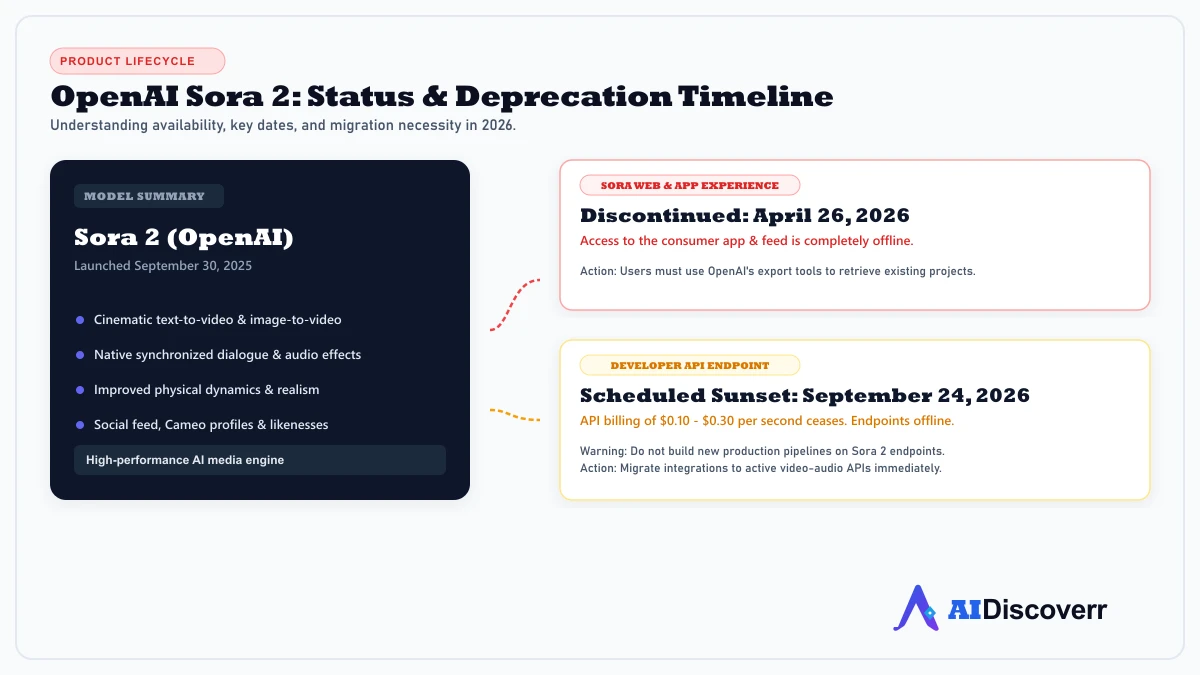
OpenAI discontinued the Sora web and app experiences on April 26, 2026. The company also announced that the Sora API will be discontinued on September 24, 2026.
That changes the search intent significantly. A current review must explain what Sora 2 was, its capabilities and pricing while it was available, its safety model, and what creators should use now as a replacement.
Sora 2 Quick Verdict
Sora 2 was a powerful short-form video-and-audio model, particularly notable for realism, physics simulation, prompt following, and synchronized audio. However, its standalone product has been discontinued. For new video projects in 2026, choose an actively supported alternative instead.
Is Sora 2 Still Available in 2026?
No, not as the standalone Sora web and app experience.
OpenAI's current documentation states that the Sora web and app experiences were discontinued on April 26, 2026.
For developers, there is another critical date: the Sora API is scheduled to be discontinued on September 24, 2026.
This distinction matters. Someone searching "Sora 2 API" may still encounter documentation or third-party wrappers. However, the existence of docs does not mean Sora is a viable choice for a new long-term production dependency.
Can existing Sora videos be exported?
Yes. OpenAI provides an export process for Sora content and recommends exporting content as soon as possible.
If you previously used Sora, ensure you export your finished videos, drafts where possible, important creative prompts, and workflow/Cameo-related material you need to preserve.
What Was Sora 2?
Sora 2 was OpenAI's next-generation video generation model released in September 2025. Compared with the earlier Sora generation, OpenAI emphasized improvements in realistic motion, physical accuracy, prompt adherence, controllability, visual quality, synchronized dialogue, and sound effects.
The model was designed to turn natural-language instructions and images into short videos. Its importance was not just visual quality; Sora 2 attempted to model how objects, people, and environments behave over time. That made it especially interesting for scenes involving complex movement, water dynamics, dialogue, and camera movements.
Sora 2 Features
Text-to-Video Generation
Users could describe a scene using natural language. Instead of manually animating every object, the creator could describe the subject, location, action, camera motion, lighting, style, dialogue, and sound, and Sora 2 would generate the video.
Image-to-Video
Sora 2 could also work from images. This was useful when a creator already had a character design, product image, photograph, or visual reference, and wanted the image to act as the starting point for a moving scene.
Synchronized Audio
Audio was one of Sora 2's defining features. OpenAI described synchronized dialogue and sound effects as part of the model's capabilities. That meant creators could generate video where audio was designed to match the visual scene instead of treating video and sound as completely separate tasks.
Improved Physics
OpenAI's Sora 2 system card highlights improvements in physical accuracy, better representing motion, object interaction, and real-world dynamics. This did not mean perfect physics; AI video models can still make errors involving object permanence, causality, hands, and complex actions. Runway's own current research, for example, identifies causal reasoning and object permanence as difficult problems for video models generally.
Cameos and Likeness
Sora's Cameo system became one of its most recognizable features. TechRadar's hands-on report described creating a personal Cameo using a recording process that captured the user's appearance and voice, which could then be used in generated videos. This opened up creative possibilities but also introduced major safety and consent questions.
Social Video Creation
The Sora app also included social features. Users could browse videos, share creations, like content, comment, follow creators, and use Cameos. OpenAI described the feed as a system intended to encourage creativity and participation.
How Did Sora 2 Work?
At a high level, the workflow was straightforward:Prompt/reference → AI generation → video + audio → review → share/export
Behind the interface, the complexity was high. Sora 2 operated as a generative model capable of modeling video and audio together, rather than simply animating a static image. OpenAI's system card describes it as a state-of-the-art video and audio generation model designed to simulate increasingly complex real-world dynamics.
Sora 2 Pricing
This section needs special care because historical Sora pricing should not be confused with current availability.
Sora's product and access model changed during its lifecycle:
- At launch, OpenAI said Sora 2 would initially be available for free with limits, while ChatGPT Pro users could access the higher-quality Sora 2 Pro model.
- The current API documentation lists Sora 2 at $0.10 per second and Sora 2 Pro at $0.30 per second for the listed video generation configuration.
However, these prices should not be interpreted as evidence that Sora 2 is a currently available long-term product. OpenAI says the Sora API is scheduled to end on September 24, 2026.
Was Sora 2 Safe?
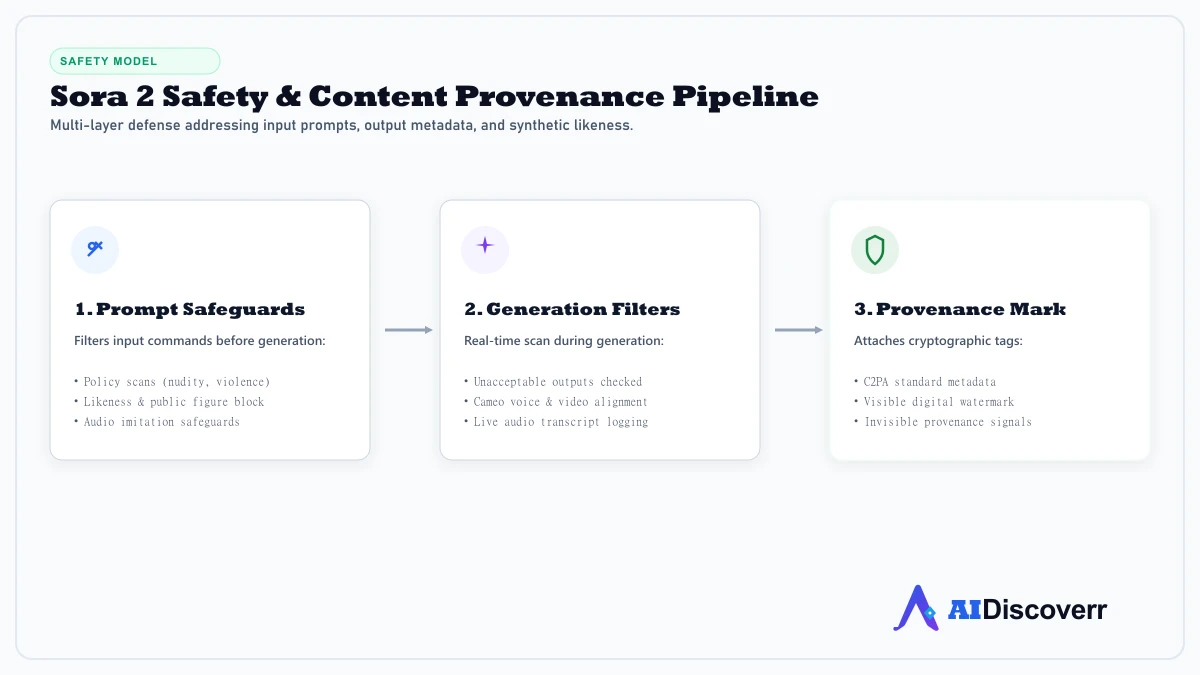
Generating realistic video creates difficult problems around deepfakes, likeness, misleading content, copyright, voice imitation, and misrepresentation. OpenAI therefore introduced multiple layers of safeguards.
C2PA Provenance
OpenAI says Sora-generated videos include C2PA metadata. C2PA is an industry standard used to provide information about digital-content provenance. This is important because realistic synthetic media can otherwise be difficult to identify.
Watermarks
OpenAI also used visible watermarking for Sora outputs during the product's lifecycle, alongside invisible provenance mechanisms. Watermarks are not a complete solution to misinformation, but they add an important signal.
Likeness Protection
Sora's ability to generate realistic people created an obvious risk. OpenAI developed controls around consent and Cameos to reduce unauthorized use of people's likenesses. However, independent hands-on reporting also showed that likeness and celebrity-related content remained complicated in practice.
Harmful Content Filtering
OpenAI says Sora's safety system checked both prompts and generated outputs. Its safeguards were designed to address categories including sexual material, terrorist propaganda, self-harm promotion, and other policy violations.
Audio Safety
OpenAI said Sora's systems scanned generated speech transcripts and used safeguards against attempts to imitate living artists or existing works in music.
Sora 2 Limitations
Sora 2 was impressive, but it was not a perfect video-production system:
- Short-form generation: Sora was primarily designed around short video generation rather than generating complete feature-length productions in one step.
- Consistency problems: Longer narratives create difficult consistency problems where characters or environments change between shots.
- Complex actions: Complicated interactions, multiple people interacting, hand movements, or precise cause-and-effect sequences can still fail.
- Content restrictions: Some users strongly disliked Sora's moderation and restrictions, reporting complaints about generation failures, load delays, and filtering.
Who Was Sora 2 Best For?
When it was available, Sora 2 was particularly interesting for:
- Content creators: For short-form social content and visual experiments.
- Marketers: For rapid creative concepts and advertising prototypes.
- Filmmakers: For storyboarding, concept development, and visual experimentation.
- AI researchers: For exploring video-generation capabilities and world-model behavior.
Who Should Not Build a New Workflow Around Sora 2?
Do not build a new production workflow around Sora 2 if you need:
- Long-term API stability
- Guaranteed future availability
- A supported standalone application
- A dependable SaaS subscription
- A new commercial video pipeline
The reason is simple: OpenAI has announced the shutdown of the Sora product and the future API discontinuation.
What Should Existing Sora Users Do Now?
If you previously relied on Sora, don't simply search for another "Sora 2" website. Instead:
- Export your existing work: Retrieve finished videos and prompts.
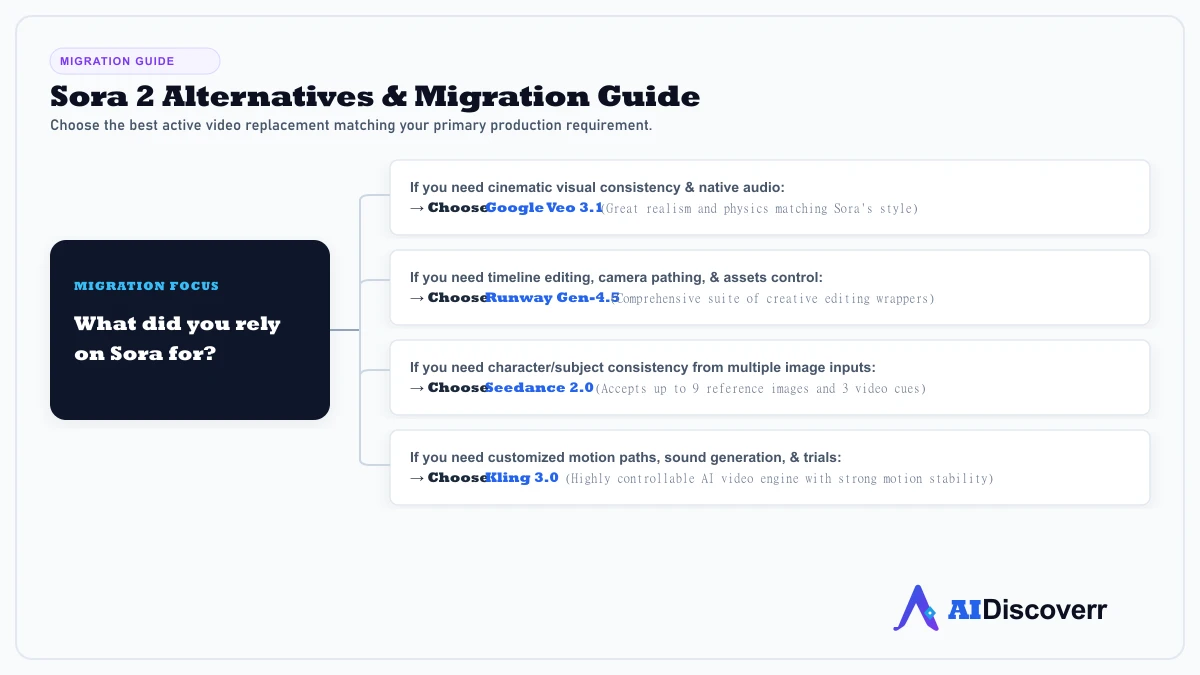
- Identify what you actually used Sora for: Was it cinematic video, audio, character consistency, or API automation?
- Choose the replacement based on that requirement: Don't choose a replacement simply because its marketing page says "Sora alternative."
Best Sora 2 Alternatives in 2026
There is no perfect one-to-one replacement, but different current models solve different problems:
Google Veo
Best for: Cinematic video and native audio. Google's Veo 3.1 supports text-to-video, image-to-video, and audio-video generation, with improved realism, physics, prompt adherence, and creative control. It is a logical choice for users who valued Sora's realistic audiovisual output.
Runway
Best for: Broader creative workflows and editing. Runway currently combines generation, editing, and access to multiple models (Gen-4.5, Seedance 2.0, Kling 3.0, and Veo 3.1) in one creative platform. Its Gen-4.5 model emphasizes motion quality, prompt adherence, and visual fidelity.
Kling
Best for: Controllable AI video workflows. Kling's current platform includes video generation, image generation, sound generation, and its Kling 3.0 model family.
Seedance 2.0
Best for: Multimodal reference workflows. ByteDance says Seedance 2.0 supports text, images, audio, and video references, making it particularly interesting for creators who need precise reference-driven video control. Read our dedicated Seedance 2.0 review to check details.
Sora 2 vs Current AI Video Generators
| Capability | Sora 2 | Veo 3.1 | Runway Gen-4.5 | Seedance 2.0 | Kling 3.0 |
|---|---|---|---|---|---|
| Current Availability | No | Yes | Yes | Yes | Yes |
| Video Generation | Yes (Hist.) | Yes | Yes | Yes | Yes |
| Native Audio | Yes | Yes | Varies | Yes | Yes / model-dep. |
| Text-to-Video | Yes | Yes | Yes | Yes | Yes |
| Image-to-Video | Yes | Yes | Yes | Yes | Yes |
| Multimodal Refs | Limited | Yes | Yes | Strong | Strong |
| Long-term Choice | No | Yes | Yes | Yes | Yes |
Capabilities change quickly, so verify the provider's current documentation before making a purchasing decision.
Sora 2 Pros and Cons
Where It Shines
Realistic physical modeling of water, motion, and environments
Synchronized audio synthesis (dialogue, ambient, music)
Strong prompt following and character Cameo consistency
Advanced image-to-video generation based on static asset inputs
State-of-the-art provenance safety framework using C2PA standards
Where It Falls Short
Standalone consumer web interface and social feed discontinued
Developer API endpoints scheduled for sunset in September 2026
Creative output generation lengths limited to short-form sequences
Content moderation restrictions disliked by segment of creators
Biometric and celebrity safety likeness rules restricted creative latitude
Is Sora 2 Worth It?
If you are deciding whether to build a new AI-video workflow or business around Sora 2: No, it is not worth it. The discontinuation of the standalone product and the scheduled shutdown of the API make it a poor technical foundation for future video pipelines. Choose an actively supported alternative instead.
Frequently Asked Questions
Frequently Asked Questions
Is Sora 2 still available?
No. The Sora web and app experiences were discontinued on April 26, 2026. The API is scheduled to sunset on September 24, 2026.
Is Sora 2 free?
Sora 2 was initially offered with free access and usage limits, while higher-quality Sora 2 Pro access was associated with ChatGPT Pro. However, the standalone Sora product is now discontinued.
What happened to Sora 2?
OpenAI discontinued the Sora web and app experiences on April 26, 2026, and announced a September 24, 2026 discontinuation date for the Sora API.
Can I still use the Sora 2 API?
The API is scheduled to be discontinued on September 24, 2026. Therefore, developers should not treat it as a long-term production dependency.
Did Sora 2 generate audio?
Yes. Synchronized dialogue and sound effects were among the model's major features.
What is the best Sora 2 alternative?
For cinematic audiovisual generation, Google Veo 3.1 is a strong current option. For broader editing and production workflows, Runway is attractive. For multimodal reference-based generation, Seedance 2.0 is worth evaluating. Kling is another major option.
Should I buy access from a website claiming to offer Sora 2?
Be careful. The official standalone Sora product has been discontinued. A third-party website using 'Sora 2' in its name is not automatically an OpenAI product. Check who operates the service, what model it actually uses, its terms, and privacy policy.
Final Verdict
Sora 2 represents a significant step in the history of generative video. It demonstrated how far models could go in simulating realistic physical behaviors and joint audio-video synthesis. OpenAI also set important industry precedents with its safety and C2PA provenance architecture.
But the 2026 verdict is practical rather than historical. Do not write code or build pipelines relying on a system scheduled for shutdown. Focus on active platforms like Veo, Runway, Kling, or Seedance that provide active, stable environments for your creative workflows.
Editorial review. Not affiliated with OpenAI. Features and API lifecycles change — check official provider documentation before planning developer pipelines.
Lead AI Tech Analyst & Editorial Director